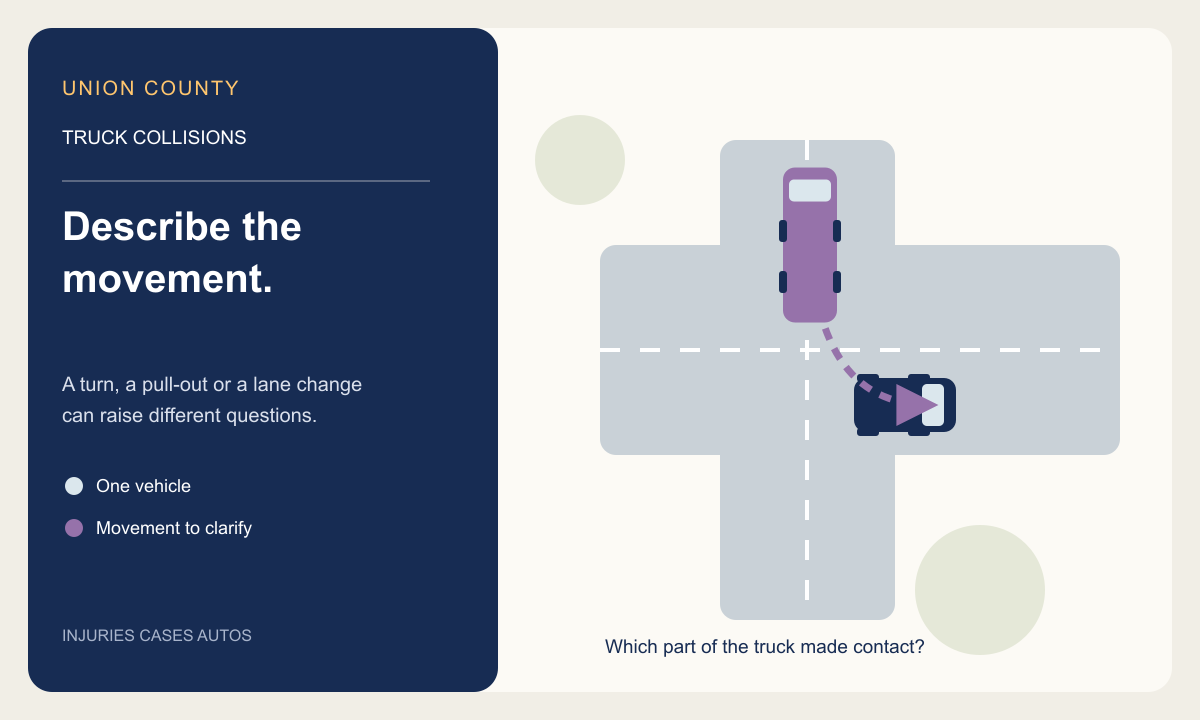
A Linden or Elizabeth delivery turn is not a Turnpike lane change
Use the road occupied at impact and the truck's actual movement to frame your question. NJTPA's 2021 county study account supports a local freight context, not proof of your driver's route.
| Collision setting | Detail that changes the inquiry | Keep this separate |
|---|---|---|
| Local street near a delivery | Backing, leaving a stop or crossing during a turn | The receiving business and the truck operator may need different identification. |
| Turnpike contact | Car beside the tractor, trailer or both before lateral movement | A cab already ahead does not show that the full trailer had cleared the car. |
| Several contacts in slowing traffic | First jolt and any later push into another vehicle | The truck's final position cannot establish impact order by itself. |
For a Turnpike record, official help identifies the toll-road request category. For a municipal investigation, retain that municipality's incident reference instead.
This section uses the linked official resources checked on October 13, 2026. It is an editorial comparison, not original crash data or a finding about your case.
Choose the guide for the movement and place
The county name covers different roads and collision sequences. Choose the description closest to what happened, including a turning or passing vehicle of a different type when that is the relevant movement.
- Elizabeth: truck identities, port destination and actual contact
- Linden: Stiles Street, Route 1 and 9 and turning trailers
- Route 22: commercial pull-out versus U-turn movement
If none fits, keep the exact approach and first contact in your own account. A neighbouring guide does not establish the rules or road layout at your collision location.
What does Union County's freight activity mean for your claim?
Freight is a documented part of the county's transport planning. A 2021 NJTPA account of the Union County Truck Mobility Study says it examined 174 miles of county roads and developed improvement concepts for ten locations. NJTPA's study account
That is useful background for understanding why trucks use local roads as well as highways. It is not a current crash ranking, proof of a defect or evidence that a driver caused your accident. A planning study and an individual collision investigation answer different questions.
For your claim, begin with the vehicle's movement, your position and the actual scene. If someone refers to a study or a road's reputation, ask how it relates to the facts being examined rather than assuming the connection is automatic.
What if the collision occurred in Linden or Elizabeth?
Give the municipality, road and cross street you know. Distinguish a delivery destination from the place of impact. A truck travelling toward a warehouse or another business may have collided elsewhere along the journey.
The study's Linden examples include Wood Avenue and Elizabeth Avenue. Those names can help locate a discussion, but a study entry does not establish current conditions at an intersection. Explain what you personally saw on the accident date, including any signs, work activity or obstruction.
If you do not know the location, provide the photographs, timestamp or scene paperwork available. Avoid selecting the nearest large business because its address is easy to find. The investigator needs the collision location, not simply a plausible address in the area.
Which truck company is involved?
Separate the name on the cab from trailer markings and the delivery recipient. Keep identifiers already captured safely and ask which business actually operated the truck. A local delivery destination or port connection does not establish employment, ownership or coverage. Explain whether you observed a delivery turn or a highway lane change, because those facts help define the investigation. Use statewide truck guide for the broader truck claim.
What if the crash was on the New Jersey Turnpike?
Keep the incident reference and any information about the roadway or interchange. Where the road has separate carriageways, describe the one you were using if you know it. That can help identify the scene without asking you to make a legal conclusion about whether the truck was allowed there.
The official crash report service allows requests for Turnpike and Garden State Parkway reports through its toll-road option. Follow the actual incident information rather than assuming a municipal report uses that route. Official toll-road report instructions
An inability to find a record immediately does not mean the investigation ended or that no claim is possible. Ask the relevant agency whether the report is pending and what identifying information should be used.
What if you were walking or working when the truck hit you?
Explain that role at the beginning of a consultation. A pedestrian, an occupant of another vehicle and a worker injured during a delivery may have different coverage and employment questions.
If you were working, keep any employer incident reference and explain whether another party was involved. Ask how any employment-related claim and a claim involving another driver should be considered. Do not assume that one insurer opening a file resolves every possible route.
If you were crossing or entering a vehicle, describe the movement and the truck's position. Do not turn a general belief about who had priority into a claim that you saw every signal or manoeuvre. Witness accounts and other evidence may help answer what you did not observe.
Who pays for medical care while responsibility is disputed?
The payment route needs your actual policies and role in the collision. A local turn, road name or report does not decide medical-benefit eligibility. Use the statewide truck injury and insurance guide to separate treatment payment from responsibility; retain any written coverage explanation for individual review.
What commercial records may need investigation?
Match a request to the disputed action: a local delivery stop, a reversing movement, a highway lane change or an equipment problem. Ask whether relevant trip records, recordings or inspection material exist and who holds them. Do not assume every truck has the same electronic data or that records will remain available indefinitely. The county freight study supplies planning context, not records of your collision. Use statewide truck guide for the wider investigation.
How can the injury affect earnings and family life?
Tell your clinician about the work and daily tasks you cannot comfortably perform. Lifting, driving, standing for a shift and caring for someone at home can require different medical guidance.
Gather actual work records and explain the period interrupted. If your income varies, ask which records would represent it fairly. Do not treat every possible future assignment as income you certainly lost.
For assistance at home, note the task and help needed in ordinary language. Concrete examples can explain the effect of an injury without turning recovery into a performance for the insurer. Tell the person reviewing the claim about improvements as well as continuing problems.
How do you assess an offer after a Union County truck accident?
Establish what the offer settles and what the release says. If care or work restrictions are continuing, ask how that uncertainty is reflected. A payment discussed in connection with one bill may be accompanied by much broader terms.
Ask a lawyer about responsibility, available coverage, documented losses, fees and expenses. Another truck accident's result is not a tariff for yours. A useful assessment explains the remaining questions rather than promising a figure because a commercial vehicle was involved.
Advertisement: Start the New Jersey accident quiz. It opens in English. Injuries Cases Autos is an informational publisher, not a law firm. No representation or outcome is guaranteed.