Route 440 contact or contact inside a shopping approach?
NJDOT's Route 440 reference distinguishes Bayonne from Jersey City sections. A store receipt or bridge destination does not identify the place a trailer first reached your car.
| Movement you experienced | Location detail to retain | Avoid assuming |
|---|---|---|
| Truck crossed beside you on the road | Occupied road, direction and whether the trailer remained alongside | That the cab being ahead meant the full truck had cleared |
| Truck turned from a property | Opening where the truck began turning and whether your car was passing it | That the receiving retailer owned or operated the truck |
| First contact followed by another impact | Each contact and the later stopping place | That the final shopping-area address was the point of first contact |
An investigator can identify the operator from actual cab/trailer details. A recognizable logo is a lead to examine, not a liability decision.
This section uses the linked official resources checked on October 13, 2026. It is an editorial comparison, not original crash data or a finding about your case.
Identify the truck movement before the shopping landmark
If you were hit near a shopping approach, say whether the truck was turning out, crossing toward an entrance or already traveling along Route 440. The opening and your occupied space matter more than the name of the nearest store.
Use NJDOT's road reference for Bayonne/Jersey City context. It does not measure truck crashes or establish current access geometry. Keep your collision observations separate from community complaints.
Why can a truck's turn create a serious conflict with another car?
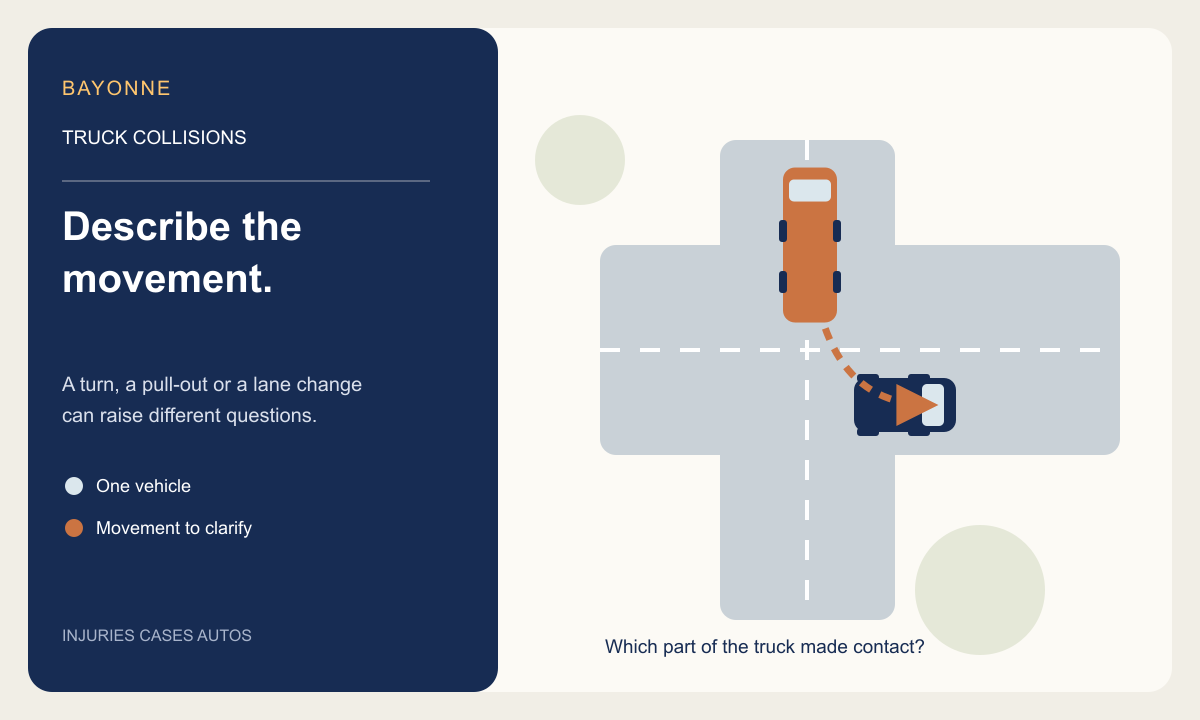
Consider a truck beginning a turn while an occupied car is alongside it. The front of the truck and the trailer do not follow exactly the same path. Contact can involve the side or rear section even after the cab has moved ahead.
For your account, describe which part of the truck struck the car and where your vehicle was positioned. If you saw the initial approach, explain it. If the first clear event was an impact along your side, do not invent what the truck driver could see before then.
The fact that a truck needs room for a manoeuvre does not answer whether its driver executed that manoeuvre safely. A lawyer or investigator can examine the movement, positions and available evidence rather than accepting “it is a big vehicle” as the whole explanation.
What if a truck changed lanes on Route 440 and hit you?
Describe whether you were continuing in your lane, slowing with traffic or already beside the truck. Explain where contact occurred and whether it pushed your car toward another vehicle or object. A second impact can be part of the same event even if the truck driver talks only about the first contact.
If the driver says you appeared in a blind spot, ask how that account is supported. The investigation still needs to consider where the vehicles were and how the manoeuvre began. Do not assume a commercial driver's description settles the issue without examining the sequence.
Keep any original recording you already have. A clip beginning at impact may miss the earlier approach, while a witness may have seen the movement from another angle. You should not need to manufacture certainty about a position you could not see.
What if the truck pulled out of a delivery or shopping entrance?
Tell the person reviewing the claim whether the truck was entering, leaving or crossing between parts of a property. Route 440 traffic and traffic within a shopping approach may be moving in different directions, and a broad store name can conceal that difference.
Identify the approach and your direction as accurately as possible. A receipt showing where you shopped is not necessarily the point of impact. If the truck belonged to a delivery operation, provide the markings or documents you have without assuming the store was its employer.
Waiting drivers may offer several different accounts. Separate what you saw from something a person told you afterward. A witness's account can help, but it should remain that witness's account rather than becoming a detail you claim to remember yourself.
What if stopped traffic suddenly moved or stopped again?
A queue can begin moving before the vehicles farther ahead have cleared the turn. If a truck driver follows too closely or moves into an occupied space, a collision may occur even though traffic is travelling slowly.
Explain whether your car was stopped when struck, whether it was pushed forward and whether another vehicle made contact. Do not treat low speed as a diagnosis or a complete measure of the injury. Tell a medical professional about your symptoms and what changed after the impact.
An injured passenger may have a different view from the driver. Describe your position and observations without feeling obliged to resolve every part of the traffic sequence. You can ask about the injury claim while the competing accounts are investigated.
Does a Bayonne Bridge journey change the collision questions?
The Bayonne Bridge connects Bayonne with Staten Island. That can explain where a truck was travelling, but a bridge journey does not establish that a collision occurred on the bridge rather than a local approach. Port Authority bridge history
For a truck that struck another car, describe the actual manoeuvre at the place of contact. A turn, lane change and rear-end impact raise different factual questions. The truck's destination is background, not a substitute for the movement.
If travel crossed state lines, mention it in a consultation along with the available insurance information. Do not decide from a route name alone which legal rules or policies resolve your particular claim.
What if the truck driver denies making contact?
Describe the first contact you saw or felt, including whether it involved the cab, trailer or another vehicle pushed toward you. Keep existing photographs or video in their original form. Damage, paint transfer or a noise may support further investigation, but none alone proves which truck moved first. Do not return to an unsafe roadway to recreate the event. Use statewide truck guide for the wider investigation questions.
How do you handle injuries, missed work and an early offer?
Call 911 for an emergency and obtain medical advice about ongoing symptoms. Explain the impacts and the work tasks affected. A vehicle inspection or a claims representative's estimate does not determine the care you need.
A repair payment and an injury release can address different losses. Use the settlement questions guide to identify what a proposed agreement covers. Get individual advice about terms you do not understand; no local maneuver establishes a settlement amount.
What can a Bayonne truck accident lawyer help clarify?
A consultation can address the driver's manoeuvre, the commercial operation involved, evidence worth obtaining and the effect of continuing treatment or work limitations. Ask who would handle the case and how fees and expenses work.
You can begin with the facts available rather than a completed investigation. Describe the urgent question first, particularly if you have an offer or someone wants a release signed. The aim is to understand your options after another driver's conduct injured you.
Advertisement: Start the New Jersey accident quiz. It opens in English. Injuries Cases Autos is not a law firm. No representation, compensation or outcome is guaranteed.