Cab, trailer and container: record each identity separately
In an Elizabeth port-area journey, different markings may describe different equipment. Retain what was captured safely; do not return to a working terminal or roadway to obtain it.
| Identifier already available | What to label | Avoid treating it as |
|---|---|---|
| Name or number on the cab | Where on the tractor it appears | Proof that the trailer or receiving business had the same operator |
| Trailer marking | Separate trailer number and logo | A complete employer or coverage decision |
| Container marking or delivery destination | Container identifier or stated destination, with its source | Proof that the first contact occurred inside the terminal |
For movement, keep the trailer position before contact even if the cab was already ahead. The truck hub explains why ownership and operation require investigation.
This section uses the linked official resources checked on October 13, 2026. It is an editorial comparison, not original crash data or a finding about your case.
Elizabeth's port setting is more than a place name
The Port Authority's trucker resource guide identifies a truck service center on McLester Street in Elizabeth and facilities on Corbin Street in Port Newark. Those are parts of a wider freight setting, with different locations across the Newark and Elizabeth port area. Port Authority trucker resource guide.
For a claim, explain whether the collision occurred on a public approach road, a highway or within a terminal-related area. Do not describe every nearby port street as Elizabeth, or assume every commercial truck in the city was carrying a container.
A box truck delivering to a shop, a tractor-trailer transporting a container and a smaller commercial vehicle may present different evidence and coverage questions. Describe what you actually saw. If you remember markings only on the trailer, explain that rather than assuming they identify the company employing the driver.
Keep the highway approach separate from the port destination
A port destination does not show where contact occurred. Identify the road and lane at impact, then distinguish an earlier highway approach from a later terminal entrance. Record whether the truck changed lanes, turned or stopped before the first contact, and whether the cab or trailer crossed your path. Do not infer cargo ownership or the operating business from the destination alone. Use statewide truck guide for the broader investigation.
Why the cab and trailer positions both matter
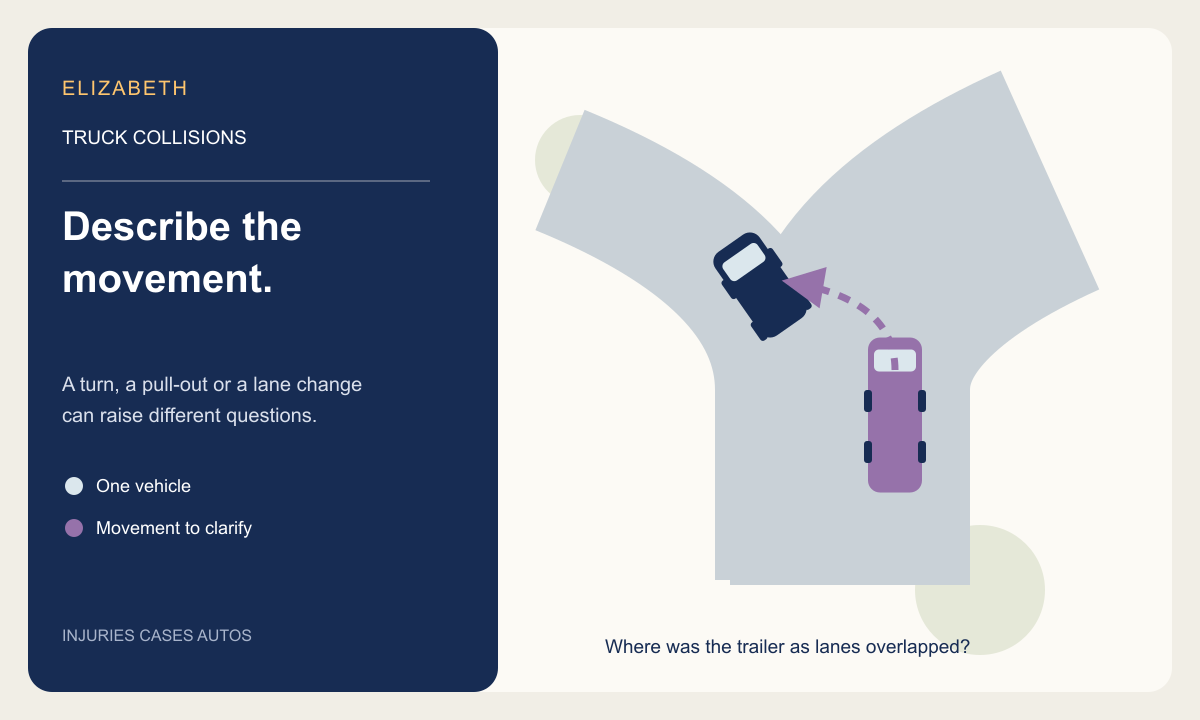
A truck's cab can clear your car while the trailer is still alongside it. In a disputed sideswipe, simply saying the truck was ahead may leave out the part that contacted you. Describe where the cab, trailer and your car were as the lanes began to overlap.
Were you already alongside the trailer when the driver moved? Did the truck come out from a neighbouring lane or continue a turn? Which part of the truck struck which part of the car? These are useful questions even if you cannot estimate the truck's exact length or speed.
Retain photographs of markings already captured safely. A cab's business name, trailer logo and container number are different identifiers. The person investigating can work out which entities matter. You should not have to guess that relationship from a logo alone.
When a wide turn catches an occupied car
One possible conflict occurs when a truck begins a turn while a car is beside it. Another occurs when the trailer follows a path closer to a stopped car than the cab's initial movement suggested. These are illustrative scenarios, not accounts of a particular Elizabeth crash.
Explain whether your vehicle was stationary, continuing straight or turning too. If you saw a signal, describe when you noticed it. Do not assume that a truck's need for turning space excuses every movement or that the car's position alone proves fault.
An injured passenger may remember the side of the car being struck and the direction the vehicle moved afterward. That observation is valuable even when they could not see the truck driver's preparation for the turn. Keep the account limited to what the passenger experienced.
A lane change near an exit is a separate conflict
If a truck moved toward an exit or split, the driver may say the car was in a blind spot. That explanation still needs examination. The relevant question is whether the driver moved safely given the occupied lane, not whether the truck had blind spots in general.
Keep any recording that shows the approach, including a period before contact. A short impact-only clip may fail to show how long the car was alongside or when the truck began moving. If another vehicle caused a reaction first, mention that as part of the sequence.
Avoid turning the claim into an argument about every confusing junction near the airport. Pin down the actual collision point and vehicles' paths. A late move toward the wrong branch can matter, but the evidence must establish that it happened in your case.
Rear-end impacts and several vehicles
A commercial truck may strike a car stopped in traffic, or contact may occur after a car moves into a gap. Describe whether your vehicle was already stopped and whether the truck's impact pushed it into another occupied vehicle.
If several vehicles were involved, identify the first contact you felt or saw. The final arrangement can be misleading when cars have moved or when a later impact caused additional damage. You do not need to assign responsibility to every driver before seeking advice.
Do not accept an exact stopping-distance explanation from someone at the scene as the final answer. The actual movement, conditions and available evidence need assessment. A truck's size matters, but it is not a substitute for understanding how this collision began.
Injuries and commercial-driver pressure
Seek medical advice for symptoms after the collision and call 911 for an emergency. Explain whether the car was struck along the side, compressed between vehicles or pushed forward. Let the clinician assess the significance rather than deciding from exterior damage alone.
For the time and duties actually affected, use the missed-work guide. Keep your actual hours, earnings and restrictions separate from a predicted recovery period. The local vehicle movement described here does not determine whether a particular loss is payable.
What to ask an Elizabeth truck accident lawyer
Ask how the responsible commercial parties will be identified and what evidence can establish the turn, lane change or braking sequence. Ask whether relevant vehicle recordings or business-held information need prompt preservation. The existence and retention of any particular recording should be checked rather than assumed.
Bring available images, the driver's information and any proposed payment or release. Explain the most urgent concern first, especially continuing symptoms or disputed blame. Ask how fees and expenses work and who will communicate with you.
The purpose is to understand your injury and the commercial-vehicle collision that caused it. You do not need to prove that all Elizabeth port traffic is dangerous or identify a trucking company's entire business structure before a useful initial conversation.
Advertisement: Start the New Jersey accident quiz. It opens in English. Injuries Cases Autos provides general information and is not a law firm. No representation, compensation or outcome is guaranteed.