Edgar Road to a local turn: identify the part that reached you
Linden's street resource calls Route 1 and 9 Edgar Road and separately lists Stiles Street, Wood Avenue and Tremley Point Road. These names help locate the movement; they are not a designated truck route.
| Before contact | Detail you can describe | Separate this from |
|---|---|---|
| Truck continued along Edgar Road | Whether the trailer was still beside your car | The cab's position ahead |
| Truck began a Stiles Street or other local turn | Original road and the part of the truck that crossed toward the car | The driver's later delivery destination |
| Truck emerged from a property | Entrance observed and whether a motorist left a gap | An assumed route from a historical planning hearing |
If a driver says another motorist waved them out, explain that motorist's lane separately from the lane your car occupied. A wave is not a view of every approach.
This section uses the linked official resources checked on October 13, 2026. It is an editorial comparison, not original crash data or a finding about your case.
Edgar Road and Stiles Street: describe the actual approach
Linden's official street information identifies Route 1 and 9 as Edgar Road and separately lists Stiles Street, Wood Avenue and Tremley Point Road. The names help distinguish the through corridor from the local streets used during a trip. City of Linden street information.
There is also a concrete historical example of industrial access. In a September 8, 2020 Linden planning hearing, an applicant described an approach from Route One through Stiles Street, West 21st Street and South Wood Avenue to Tremley Point Road, with a return using Twentieth Street. That was testimony about one proposed operation. It is not a present-day designated truck route or proof that your truck followed that path. Linden planning-hearing transcript.
The useful point for an injured occupant is that “a truck on Route 1 and 9” can leave out a local turn or property entrance. Identify where the truck began changing direction. If you remember a street sign, an entrance or which side of Edgar Road you were on, explain it. Do not substitute the truck's destination for the location where it struck you.
The cab clears you, but the trailer does not
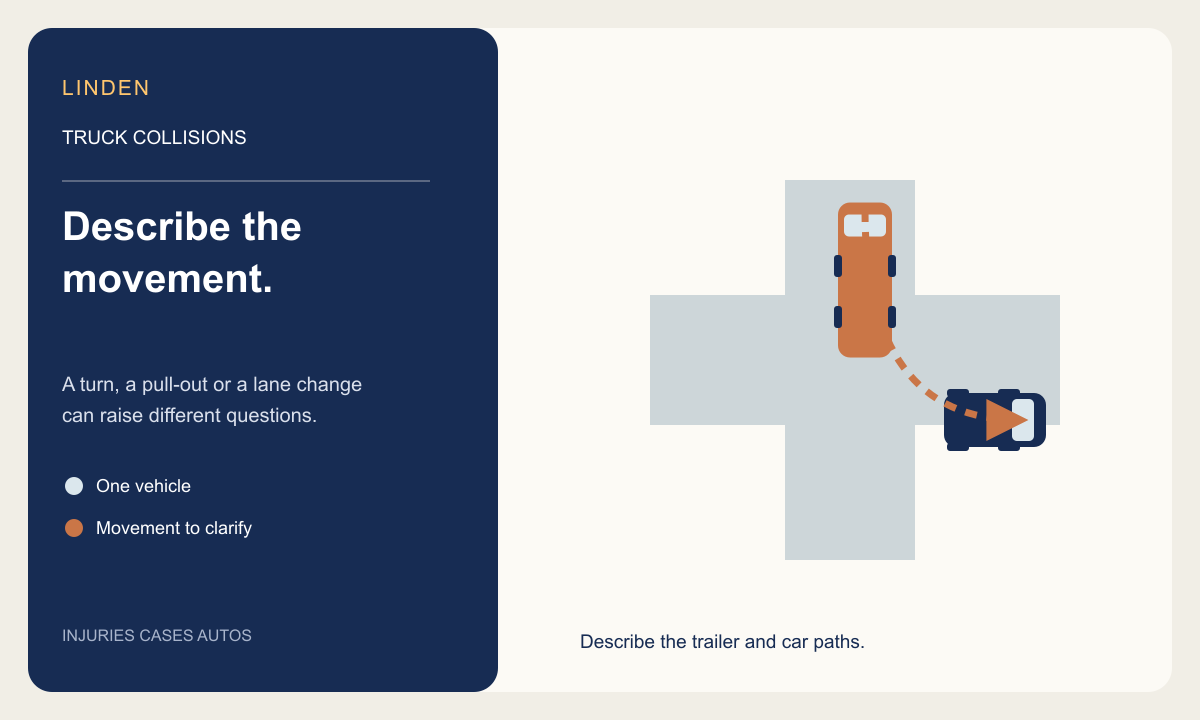
Consider this hypothetical example: your car is stopped near a corner as a tractor-trailer turns. The cab passes, then the trailer contacts the side of your car. This is an illustration of a turning conflict, not a reported Linden case.
In that situation, the truck's final position may make it appear to have been ahead throughout. Your account should describe the trailer's position at contact and whether your car moved before the impact. A passenger on the struck side may remember something different from the driver watching the cab.
Avoid reducing the explanation to “the truck took a wide turn.” Was the truck turning from the next lane, swinging outward first or already turning when it reached you? Which part contacted the door, rear quarter or front corner? Those details help distinguish the movement without requiring you to know a trailer's dimensions.
The driver's explanation about needing space is something to examine. It does not, by itself, answer whether the truck entered space occupied by another vehicle safely. Equally, the presence of a large truck does not establish responsibility before the sequence is understood.
Turning out of an entrance is a different problem
A truck leaving a property can enter the travel lane gradually or cross several lanes during a turn. Tell the person assessing your injury whether you were travelling along Edgar Road, waiting at a signal or already turning when the truck appeared.
The point where you first could see the truck matters. You may have seen its cab at the driveway while another vehicle blocked your view of the trailer. Describe that limited view accurately. A recording of the approach may establish more than an estimate made after the collision.
If the driver says another motorist waved the truck out, distinguish that motorist's lane from yours. A wave in one lane does not establish that every other lane was clear. The investigation should examine the complete path, including whether the truck stopped again before entering your lane.
You do not need to accuse the property owner or turn the claim into a road-design dispute. The immediate question is how the truck and occupied car came into contact, and which driving decisions contributed.
A lane change near Stiles Street or Wood Avenue
Sometimes the collision happens before the turn. A truck moves into the lane it wants for an upcoming junction and contacts a car already alongside. Explain whether the trailer crossed the lane line or whether your car was squeezed toward a vehicle in another lane.
A blind-spot explanation does not establish how long your car was there or what checks the driver made. Keep an original dashcam file if you have one, including the seconds before impact. An impact-only clip may omit the period when both vehicles travelled beside each other.
If you moved too, say so. A useful account includes both movements and any uncertainty about their timing. Responsibility for a side impact collision cannot be determined from a truck logo or the final resting positions alone.
Which commercial vehicle and business were involved?
Keep the cab, trailer and any container identifiers separate. A retailer's branding, a trailer logo or a delivery destination may identify different businesses. Record only identifiers already captured safely, then ask who owned and operated the vehicle and whether business-held trip information exists. Do not assume that an industrial-area truck was going to the port. Use statewide truck guide for the broader truck investigation.
Injury care when the car was struck along its side
Call 911 for an emergency and seek medical assessment after the collision. Describe where you sat, which side was hit and whether your body contacted the door or interior. Let the clinician assess your injuries rather than judging them by the size of a dent.
A passenger may need help arranging follow-up care while the driver handles the vehicle. Each person's symptoms and treatment should be described separately. The driver's ability to return to work does not establish that an injured passenger can do the same.
If work involves lifting, standing or driving, explain the actual difficulty to your clinician. A lost wages claim needs a truthful account of time missed and earnings affected. Keep employer or self-employment information relevant to those losses, without treating a projected recovery date as a medical conclusion.
Treatment payment and an early truck accident settlement
The payment route needs your actual policies and role in the collision. A local turn, road name or report does not decide medical-benefit eligibility. Use the statewide truck injury and insurance guide to separate treatment payment from responsibility; retain any written coverage explanation for individual review.
Preparing a useful Linden truck accident consultation
Start with the movement that caused the impact: a turn from Edgar Road, a property pull-out or a lane change before Stiles Street. Then explain the injury concern and anything the other driver disputes. You can seek advice with incomplete information while being clear about what you know.
Ask how the turn will be reconstructed, which commercial parties need identification and what evidence may be time-sensitive. Ask about fees, expenses and who will communicate with you. The goal is a practical assessment of your collision and injury, without borrowing someone else's results.
Related guides: New Jersey truck accident help, Union County truck accident help and Elizabeth truck accident help.
Advertisement: Start the New Jersey accident quiz. It opens in English. Injuries Cases Autos provides general information and is not a law firm. No representation, compensation or outcome is guaranteed.