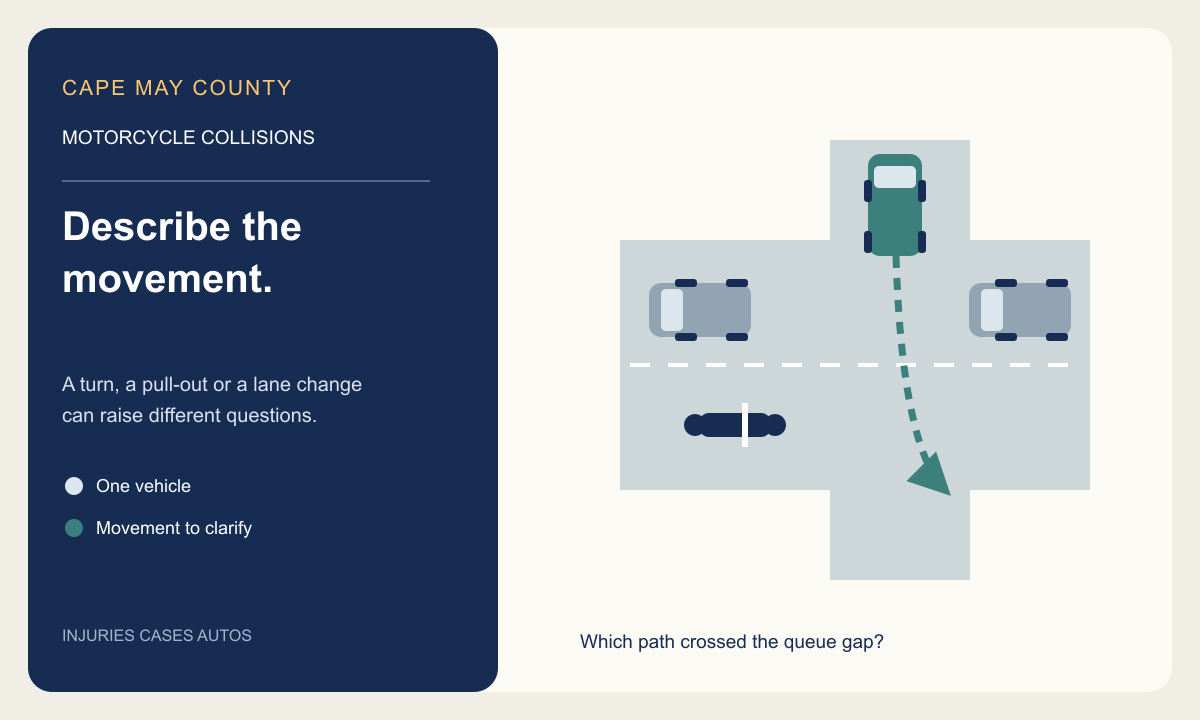
Route 47 in Dennis Township: identify the crossing origin
The NJDOT Route 47 reference separates Dennis Township from Middle Township and the Cumberland County segment beyond it. The ride's shore destination is not the junction where a car crossed.
| Origin you observed | Question for the turning conflict | Do not infer |
|---|---|---|
| Opposing Route 47 car | When did it begin crossing the rider's path? | Its signal from an old improvement release |
| Car entered from Route 83 or another junction | Which approach and current control faced that car? | That every Route 47 junction has the same priority |
| Car came through a stopped queue | Which lane left a gap and where the rider was traveling? | That the waving driver could see every occupied path |
Describe vehicle contact and the later fall separately. A photograph of the bike on the ground cannot show the full crossing approach. Keep uncertainty where your view was blocked.
This section uses the linked official resources checked on October 13, 2026. It is an editorial comparison, not original crash data or a finding about your case.
Identify the junction before explaining the turn
NJDOT's Route 47 reference separates the road's sections in Wildwood, Lower Township, Middle Township and Dennis Township. Route 47 continues beyond Cape May County into Cumberland County. The route number alone therefore does not establish the municipality or even the county where contact occurred. NJDOT Route 47 reference.
For Dennis Township, official historical releases identify the Route 47 and Route 83 junction and the separate Route 47 junctions with Petersburg Road and Tyler Road. They describe work in 2007 and 2008. Those dates establish that the sources are historical, rather than evidence of present construction or the precise controls on your collision date. Route 47 and Route 83 release and Petersburg and Tyler Road release.
If the car was entering from Route 83, say that rather than describing it as a car already on Route 47. If the turn was near Petersburg Road, identify that junction separately. The starting road affects the paths someone needs to investigate.
A gap in one queue does not show the whole approach
Imagine this hypothetical sequence: drivers in one line stop and leave a gap. A car begins crossing through it toward a side road while a motorcycle approaches on another path. The rider and turning car collide. This is an illustration of a crossing conflict, not an actual local case.
Explain whether the queue was travelling in your direction or the opposite direction. Was the motorcycle moving in a marked travel lane, and what could you see through or around the stopped vehicles? State those facts without assuming the person waving had a view of every approach.
If the other driver says someone let them through, ask which driver and lane they mean. That explanation may clarify why they moved. It does not independently establish whether the rider's path was clear or how the turning motorist checked it.
The rider's own movement also matters. If you changed position or passed another vehicle, describe it. A fair account can include that movement without accepting the conclusion that riding a motorcycle caused the collision.
Left turns, side approaches and the last moment before contact
An oncoming driver turning across a rider and a car entering from a side road can produce similar damage. Their approach paths are different. Identify whether the car was facing you, emerging from beside you or moving in the same direction before it turned.
If you observed a signal, state when you saw it and which approach it faced. Do not borrow an assumption about a present signal from a 2008 improvement announcement. The current arrangement and its operation at the time need checking.
A useful description may be limited to a few visible events: the car moving forward, braking and contact. You do not have to convert those observations into exact speeds or distances. If part of the impact is missing from your memory, explain the gap.
Someone investigating may compare the account with an independent witness or recording. A person who saw the approach can answer different questions from someone who arrived after the rider was already down.
Your shore destination may not describe your direction
Heading toward Cape May or returning from Wildwood describes the trip, not necessarily the motorcycle's direction at contact. Identify the Route 47 segment, direction and nearest junction you know, then describe where the other car began its turn. A companion may know the route without having seen the car's movement. Avoid substituting an assumed summer traffic pattern for conditions on the collision date. Use statewide motorcycle guide for the broader claim questions.
Where the motorcycle and car made contact
Explain whether the car struck the bike, the rider or both, and whether the motorcycle then fell or moved into another vehicle. The first contact and later impacts should be distinguished where you can remember them.
If the motorcycle's front contacted the side of the car, that does not by itself explain why the car was in its path. Equally, damage along the bike's side does not settle every responsibility question. The earlier approach is still needed.
Preserve safely obtained photographs and original video. Keep available damaged riding equipment until you have asked whether it may be relevant. Retaining an item for assessment does not establish that it is safe to use again.
An injured motorcycle passenger has a separate account
A passenger may have seen the turning car through a different angle, or may remember the impact more clearly than the rider. Keep each account limited to that person's observations. There is no need to make the memories identical where the views differed.
Tell the clinician where you were sitting and whether you separated from the motorcycle. Explain which parts of your body contacted the car, bike or ground if you know. Your injuries should be assessed individually even if the rider's condition is different.
For a passenger injury claim, identify who owned the bike, who was riding and whether another driver's movement contributed. If the rider is a friend or family member, mention that during a consultation and ask how the passenger's position will be assessed.
Treatment and work after the collision
Call 911 for an emergency and seek medical assessment. Explain symptoms and the sequence you experienced. The ability to stand or speak after the impact should not replace an assessment by a clinician.
If gripping, walking, climbing stairs or normal work has become difficult, describe the actual change. Tell the treating professional about changes after the first visit. Do not decide that a symptom is a particular neurological or spinal injury from an online search.
Ask the clinician about activity and follow-up appropriate to your condition. If you are away from home, explain that so treatment continuity can be discussed. An article cannot decide when you can ride again or predict how long you will be unable to work.
For earnings losses, distinguish work actually missed from possible future disruption. Explain whether you are employed or self-employed and ask what information is useful for the loss being assessed. A busy season does not automatically establish a particular compensation amount.
Insurance and a Cape May County motorcycle consultation
Ask for a review of the actual motorcycle policy, relevant health coverage and the other driver's liability insurance. Do not assume the treatment-payment arrangement from a car accident applies identically to a motorcycle injury.
If someone says one benefit is unavailable, ask which benefit and policy they mean. That statement may not resolve the whole injury claim. An injured passenger should also have their own coverage questions examined rather than relying on an assurance given to the rider.
Start the consultation with the junction, crossing movement and injury concern. Ask how the queue, driver's view and rider's approach will be investigated. Bring any proposed release and ask what it settles, what expenses apply and who will communicate with you.
Related guides: New Jersey motorcycle accident help, Monmouth County motorcycle accident help and West Orange motorcycle accident help.
Advertisement: Start the New Jersey accident quiz. It opens in English. Injuries Cases Autos provides general information and is not a law firm. No representation, compensation or outcome is guaranteed.