Pleasant Valley Way access: approved plan versus collision-date scene
The 2022 planning resolution describes one property's approaches. It cannot establish every nearby driveway or prove installation by your collision date.
| Source detail | What it supports | What still needs checking |
|---|---|---|
| Right-turn entry/exit described on Pleasant Valley Way | The movement proposed for that property | Actual opening used and posted control on the relevant date |
| Separate Mount Pleasant access discussed | Why a nearby junction and driveway are different origins | Which approach the other car occupied before turning |
| Right-turn-only exit signs required by the approval | A plan condition | Whether the signs were installed and faced the driver at impact |
If you saw only the car emerging, say that. Do not turn a historical plan restriction into something you claim to have observed at the scene.
This section uses the linked official resources checked on October 13, 2026. It is an editorial comparison, not original crash data or a finding about your case.
A local source that distinguishes a driveway from the junction
West Orange's Planning Board addressed access at the corner of Pleasant Valley Way and Mount Pleasant Avenue in a resolution decided July 6, 2022 and memorialized August 3, 2022. For one property, the plan described right-turn entry and exit on Pleasant Valley Way and separate access from Mount Pleasant Avenue. West Orange planning resolution.
The record gives a specific example of why the side of a property and the direction of a turn matter. A car leaving a driveway on Pleasant Valley Way is making a different movement from one turning through the nearby signalized intersection.
This historical approval does not prove that the proposed work was completed or that particular signs remain in place. It also does not establish a crash at that property. Your collision location, controls and driver movements need their own verification.
When describing where you were hurt, identify whether the car emerged from a property entrance or approached through the junction. “Near Mount Pleasant” can conceal that distinction. Describe the entrance you actually saw rather than assigning it to a business from memory.
What “I did not see the motorcycle” leaves unanswered
The driver's statement does not establish whether their view was clear, how they checked or how long you had been approaching. Explain your travel direction and the point where you first saw the car move.
If another vehicle blocked the view, describe its position. It may have hidden you from the turning driver, hidden the driver from you or affected both. A recording or witness may clarify what each person could see.
Do not turn a brief memory into an exact speed estimate. You may remember braking, a horn or the car continuing to move. Those observations are useful even if you cannot say how many feet separated the vehicles.
The fact that the motorcycle contacted the car does not, by itself, establish which driver caused the conflict. The approach and crossing movement need examination. An insurer should have more to assess than the final place where the motorcycle stopped.
A pull-out into the rider's lane
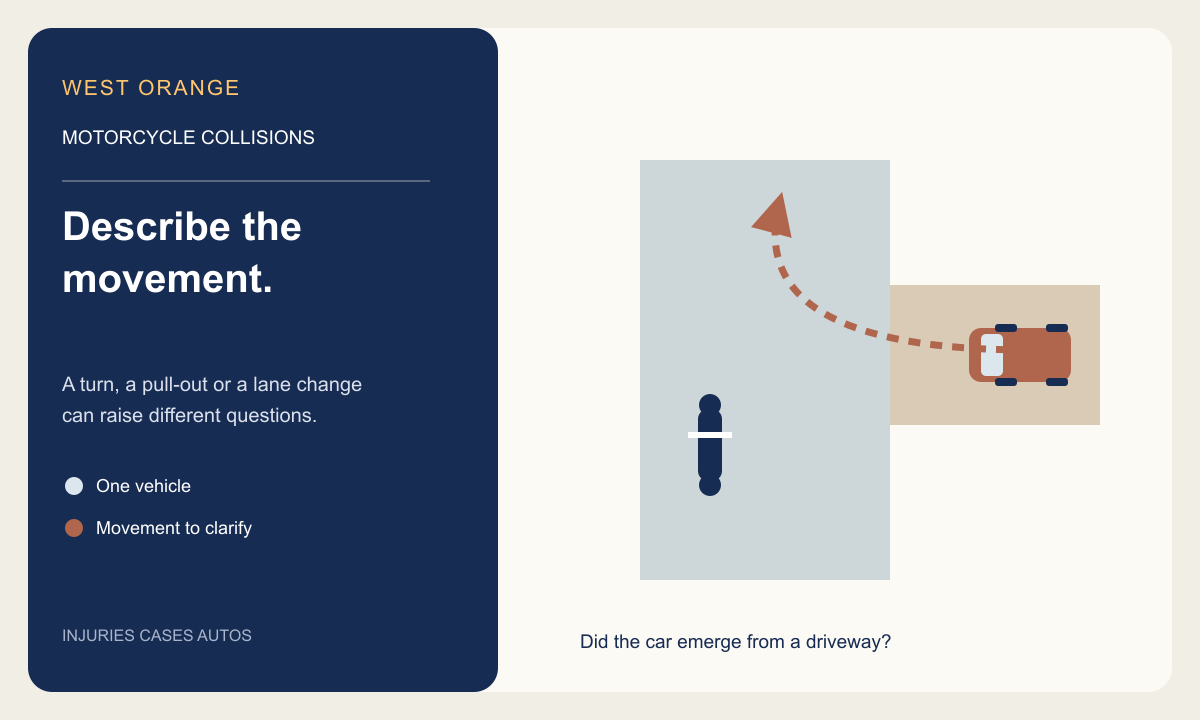
Here is a hypothetical example: a driver leaves a Pleasant Valley Way property entrance while a motorcycle is travelling along the road. The car initially edges forward, then moves farther into the rider's path. Contact happens before the rider can pass. This is an illustration, not an actual local case.
Explain whether the driver stopped before entering and whether the car was turning toward your direction of travel or crossing it. A right turn that occupies your lane and a crossing turn create different paths, even when both are described casually as pulling out.
If the other driver says a motorist waved them out, identify which vehicle and lane they mean. A courtesy wave may explain why the driver began moving; it does not independently establish that your lane was clear.
Current signs may matter, but their presence should be checked. Avoid alleging a violation solely because an older planning document proposed a restriction at a nearby property. The evidence should connect the actual entrance and movement to your collision.
The turning car near Mount Pleasant Avenue
A junction collision may involve an opposing car turning across the motorcycle, a car entering from another approach or a vehicle changing direction beside the rider. Name the street each vehicle approached from and the intended turn if you know it.
If you observed a signal, explain when you saw it. The signal facing one approach may differ from another. A passenger may not have seen either and should not feel obliged to fill that gap.
Traffic stopped in one lane can also make a crossing movement harder to understand. Describe whether you were moving beside a queue and whether the car emerged through a gap. Avoid relying on a general claim that traffic was stopped to explain every lane.
For a motorcycle accident consultation, an independent account of the approach may be particularly useful when the driver says the rider appeared suddenly. A witness who arrived afterward can describe the scene, but may not know how the paths crossed.
Contact, the fall and injuries are parts of one sequence
If another vehicle struck your motorcycle and you then fell, describe both stages. Which part of the car contacted the bike or rider? Did you separate from the motorcycle immediately or after it changed direction? These details help explain the event without claiming a particular injury mechanism yourself.
A rider may remember the car approaching but have a gap around impact. A passenger may remember the side contact more clearly. Keep those accounts separate rather than trying to make them identical.
Retain damaged riding equipment if available and ask the person advising you before discarding potentially relevant items. Keeping equipment for assessment does not establish that it is safe to use again. Do not return to active traffic to search for items or recreate the event.
Medical care and returning to normal activities
Call 911 for an emergency and seek medical assessment. Tell the clinician whether the car struck you directly, whether you fell and which parts of your body contacted the vehicle or ground. The ability to stand immediately afterward should not replace assessment.
Describe limitations relevant to your daily life: gripping, walking, climbing stairs, sleeping or working. Let the treating professional know if symptoms change. Avoid assigning yourself a diagnosis based on a search for traumatic brain injury or spinal cord injury.
If you carry a passenger, their medical needs are separate from yours. The rider's condition and the passenger's condition should not be bundled into one assumption about the severity of the collision.
Ask your clinician about activity and work restrictions appropriate to your condition. An article cannot decide when you can safely ride again. Keep actual medical advice separate from pressure to return to work or finish an insurance claim.
Motorcycle insurance needs a specific review
Do not assume the treatment-payment arrangement familiar from a car accident applies identically to this motorcycle collision. Ask for a review of the motorcycle policy, relevant health coverage and the other driver's liability insurance.
If someone says a benefit does not apply, ask which benefit and policy they mean. That answer may not resolve the entire injury claim. Equally, possession of a motorcycle insurance card does not guarantee every medical or income loss is covered.
If the driver was uninsured or underinsured, raise that issue during the policy review. Ask what coverage, if any, could respond under the actual contracts and facts. Avoid treating a general uninsured motorist description as a promise of payment in your case.
An injured motorcycle passenger should explain who owned the bike, who was riding and what other coverage may be relevant. The passenger injury claim deserves its own assessment, especially if more than one driver's conduct needs investigation.
A useful West Orange motorcycle accident conversation
Start with the difference between the driveway pull-out and the junction turn. Ask how the driver's view and the rider's approach will be examined, and which current signs or recordings need checking. Explain any uncertainty rather than relying on a stereotype about motorcycle riders.
Bring an early offer or release if one has arrived. Ask what it settles, how continuing treatment is considered and what fees and expenses would apply. No reliable injury settlement amount follows from the route name, riding equipment or another person's story.
Related guides: New Jersey motorcycle accident help, Wayne motorcycle accident help and Monmouth County motorcycle accident help.
Advertisement: Start the New Jersey accident quiz. It opens in English. Injuries Cases Autos provides general information and is not a law firm. No representation, compensation or outcome is guaranteed.