Parker Avenue: match direction and vehicle criterion first
The NJDOT Route 130 turning table has separate Burlington Township entries at approximate milepost 48.45. This summary identifies what needs individual source-and-scene review; it does not decide a driver's violation or fault.
| Published movement entry | Vehicle condition in that entry | Fact to establish |
|---|---|---|
| Northbound Route 130 left onto Parker Avenue westbound | No truck-only criterion stated in this left-turn entry | Original approach and intended turn |
| Northbound U-turn at Parker Avenue | No weight qualifier stated in that entry | Was it a reversal of direction or a different turn? |
| Southbound U-turn at Parker Avenue/McAllister driveway label | Vehicles over four tons gross vehicle weight | Relevant vehicle weight evidence, exact opening and collision-date rule |
Do not infer a four-ton condition from appearance or use one direction's entry for the opposite movement. The truck's lane change before reaching an opening may be the contact to investigate.
This section uses the linked official resources checked on October 13, 2026. It is an editorial comparison, not original crash data or a finding about your case.
Route 130 has specific turning rules, not one universal rule
NJDOT's Route 130 turning table separates Burlington City, Burlington Township and Florence Township. In Burlington Township, it lists a prohibition on turning left from northbound Route 130 onto Parker Avenue, at approximate milepost 48.45. It also lists a southbound U-turn restriction there for vehicles over four tons gross vehicle weight. NJDOT Route 130 turning restrictions.
The table has different entries for Ronald Drive, Gilbert Street and Florence-area entrances. The useful point is specificity. The approach direction, exact opening, intended movement and any applicable vehicle-weight condition need checking together.
This is not a claim that a particular truck violated a restriction. Its appearance does not establish gross vehicle weight. Nor should a driver's description of a necessary delivery substitute for identifying the permitted movement. A person assessing your collision needs the actual location and vehicle information.
When a truck starts reversing direction beside your car
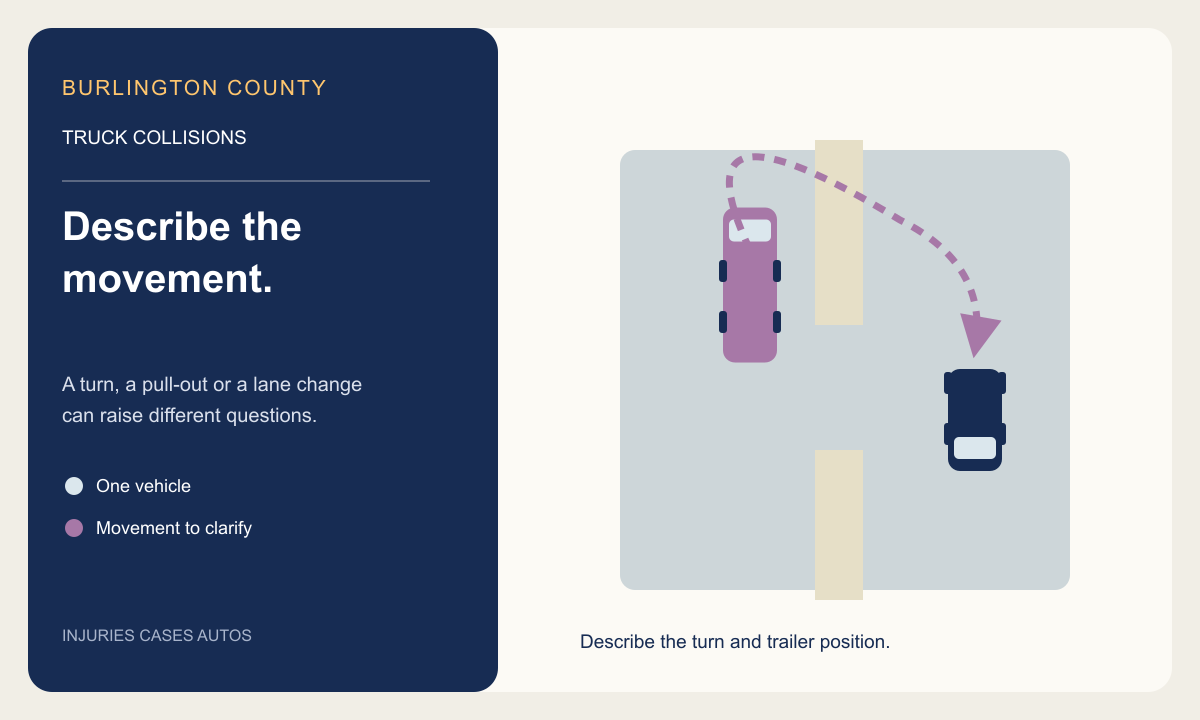
Consider a hypothetical example: a commercial vehicle begins a U-turn while a car is travelling beside it. The truck's front clears one space, but its body or trailer contacts the car as the turn continues. This is an illustration, not a reported Burlington County case.
Describe where the car was when the truck began changing direction. Were you already alongside, following behind or waiting on an opposing approach? Explain whether the truck signalled or slowed before the turn, while avoiding an exact speed estimate you cannot support.
The position of the cab and the part that struck you may differ. If a trailer contacted the car, say so. If the truck was a rigid box vehicle, do not describe it as a tractor-trailer simply because it was large.
A U-turn explanation should also be distinguished from a wide left turn into a property. If you are unsure which the driver intended, describe the movement you saw and say the intended destination is uncertain. That is more useful than choosing a label that may be wrong.
The lane change before the turn can be the collision
The truck may never complete the intended turn because contact happens while it moves toward the opening. Explain whether it crossed a lane line into your car before reaching the entrance or median break.
A driver may say the car was in a blind spot. Ask how long the car had been beside the truck and what evidence shows the approach. A recording that begins before the movement may clarify that issue better than an impact-only clip.
If your car also changed lanes, describe that movement. An investigation should test the complete sequence, including any third vehicle that caused a reaction. A turn restriction can be relevant without proving every fact about the earlier contact.
The exit intention and the lane change are different
A truck heading for an entrance may turn from its lane, move across your lane first, or brake while a following vehicle strikes you. Describe which action you actually observed on Route 130 and the order of contact. A destination or turn signal does not by itself establish the truck's earlier lane position. Keep the verified direction and weight conditions in the local rule table separate from the facts still disputed. Use statewide truck guide for the broader investigation.
Braking behind the turning truck
Sometimes the injury comes from a following impact after a truck stops or turns. Your car may have stopped behind it, then another driver strikes you. Or a vehicle cuts into the gap immediately before several cars brake.
Explain the first impact you felt and whether it pushed your car into the truck or another vehicle. The vehicle that contacted you first may differ from the vehicle whose movement started the sequence. Both questions can matter.
If someone says the rear damage settles responsibility, ask how the earlier movements are being considered. The final arrangement does not automatically show which car had been stopped or where the original gaps were.
An injured passenger should describe the order of impacts and their position. They may not have seen the turning truck, but may remember being pushed forward and then experiencing a second contact.
The truck's weight and business need evidence
Where a restriction uses gross vehicle weight, ask how that fact will be established. A logo, trailer height or cargo guess is not a reliable substitute. The relevant records and vehicle identifiers should be examined by the person investigating.
Similarly, the company receiving a delivery may not own or operate the truck. Preserve safely captured markings and identification, distinguishing the cab from the trailer. Avoid accusing every business named on the vehicle of having directed the movement.
Ask whether trip instructions, vehicle recordings or other business-held information exist. Their availability and retention need checking. A delivery driver's statement about where they were going can help the inquiry without proving how they were told to reach it.
Injury, care and work disruption
Call 911 for an emergency and get medical advice about symptoms after the impact. Explain whether the car was struck sideways, compressed between vehicles or hit more than once. Let the clinician assess the significance rather than deciding from a repair estimate.
For the time and duties actually affected, use the missed-work guide. Keep your actual hours, earnings and restrictions separate from a predicted recovery period. The local vehicle movement described here does not determine whether a particular loss is payable.
Before agreeing to a private payment or injury settlement
If the driver or a business offers to handle the matter privately, establish what the proposed payment covers. It may concern a vehicle repair while saying nothing about continuing treatment. Read the agreement rather than relying on an informal description.
For a consultation, identify the Route 130 opening, direction of travel and movement you remember. Ask how the restrictions, vehicle facts and sequence will be checked. Ask which coverage may apply to the injury and how treatment-payment questions will be handled.
Also ask about fees, expenses and communication. The size of the truck and a delivery's commercial value do not determine an injury settlement. Your actual injury, losses, responsibility and applicable coverage need assessment.
Related guides: New Jersey truck accident help, Mercer County truck accident help and Linden truck accident help.
Advertisement: Start the New Jersey accident quiz. It opens in English. Injuries Cases Autos provides general information and is not a law firm. No representation, compensation or outcome is guaranteed.