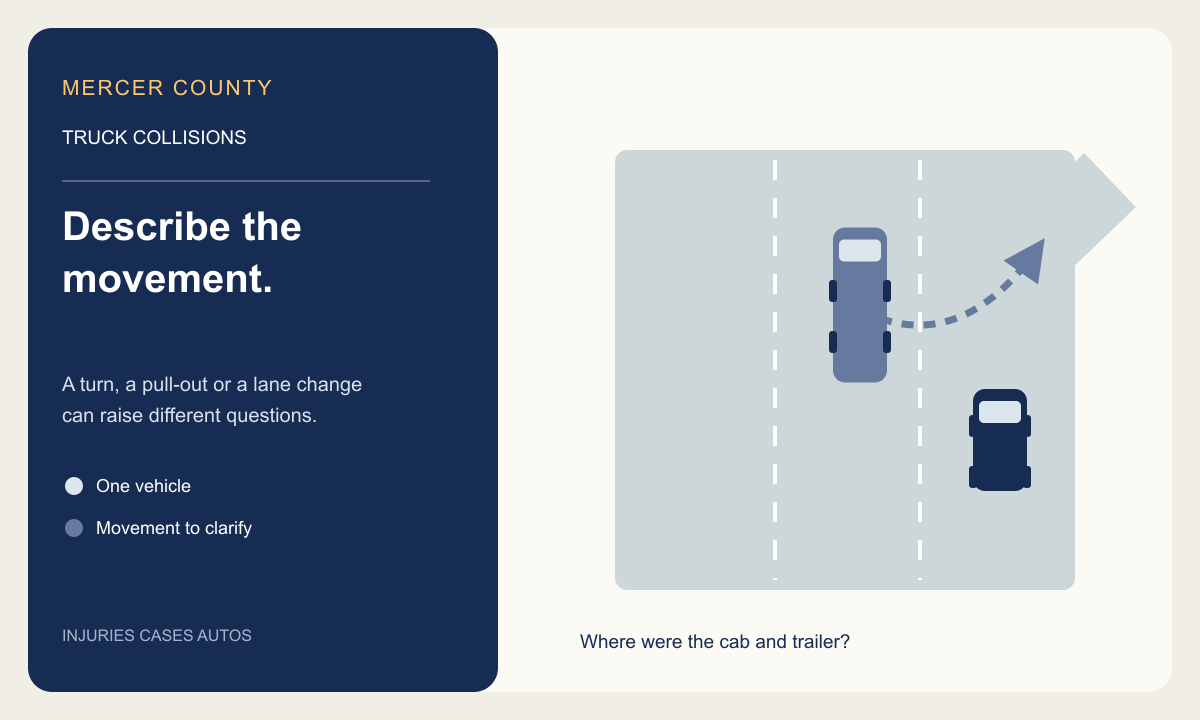
Separate the documented corridor from the truck's observed path
A truck's destination at a commercial property does not prove it had already left Route 1 when contact occurred. If its tractor passed but the trailer remained beside you, describe where your car was when the trailer first reached it. Keep the commercial trip label separate from that observed path.
| Source or movement | Established point | Limit |
|---|---|---|
| NJDOT Route 1 reference | Lawrence and West Windsor are Mercer segments; Plainsboro is Middlesex. | A Princeton-area destination does not identify the collision county. |
| 2018 widening release | Southbound work between Nassau Park Boulevard and Quakerbridge overpass described through and local access. | A historical plan does not certify today's lanes or completed driveways. |
| Collision account | Truck on through road, moving toward local access, or returning from property. | Establish the actual origin and first lateral movement from collision-date evidence. |
Source check: October 13, 2026. NJDOT Route 1 municipal reference; NJDOT March 2018 corridor release.
Which movement was the truck making?
Start by distinguishing a truck continuing along Route 1 from one entering or leaving commercial access. A driver may mention a delivery destination while leaving the movement itself unclear. Explain whether the truck crossed a lane line, entered from a ramp or slowed ahead in the same lane.
If you were in a local lane, identify that as accurately as possible. If you were continuing through, explain that instead. Avoid calling any lane beside a shopping area a local lane without checking the road arrangement.
An original recording can help orient both movements. It may show signs, the point where the truck began moving and how long your car was beside it. A final photograph beside a business does not independently establish where the truck intended to go.
The trailer crosses before the truck reaches its access
Consider a hypothetical example: a tractor-trailer moves toward a commercial approach while a car is still alongside its trailer. The cab may already be in front of the car, but the trailer contacts the occupied side. This illustrates a lane-change conflict, not an actual Mercer County case.
Describe the part of the truck that made contact. If you saw the cab move before the trailer reached you, explain the order. If the vehicle was a box truck rather than a tractor-trailer, keep that distinction clear.
The driver's claim that the truck was ahead may describe only the cab. Ask what evidence establishes the trailer's position and your car's position as the movement began. A blind-spot explanation likewise needs examination rather than acceptance as a completed responsibility assessment.
If your car changed lanes too, describe that movement. An investigation should compare both paths and their timing. It should not decide the sequence simply from a logo, the truck's size or which driver spoke first.
Keep the local rule separate from the disputed movement
Use the dated release to identify the access-versus-through question, not to assign a lane to either driver. The auxiliary lane and third express lane were described as proposed project work, not verified current arrangements. If the precise access layout matters, compare an original clip or dated road record with the point of contact.
Care and the next useful conversation
Call 911 for an emergency and seek medical advice. Describe whether the car was struck along its side, pushed forward or contacted more than one vehicle. Tell the clinician where you sat and whether your body struck the interior.
For treatment payments, work losses, coverage and proposed releases, use the focused guides: New Jersey truck accident help; Describing several vehicle impacts.
Advertisement: Start the New Jersey accident quiz. It opens in English. Injuries Cases Autos provides general information and is not a law firm. No representation, compensation or outcome is guaranteed.