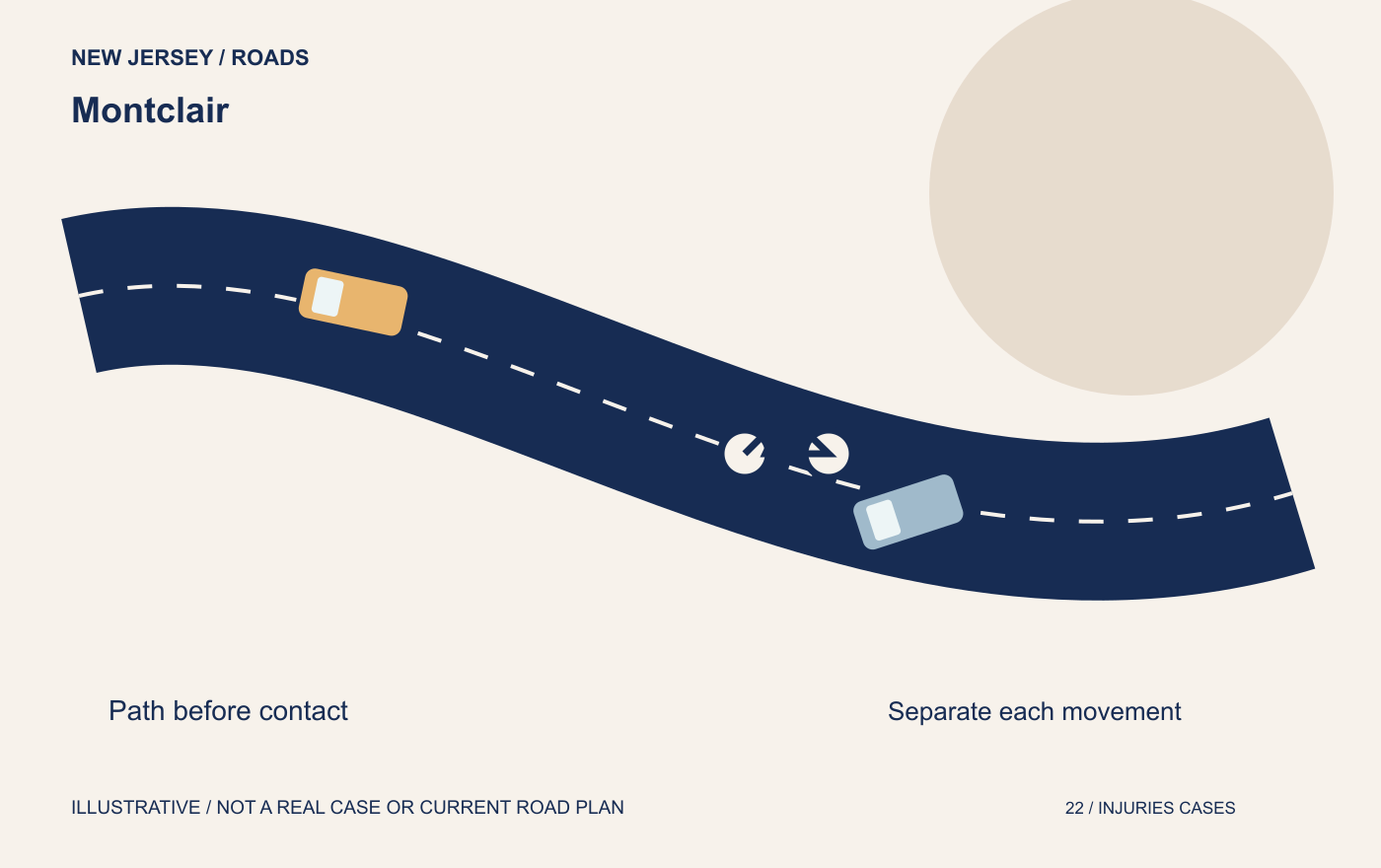
Keep the Grove Street segment and entry direction together
For a rider, the first distinction is the car's origin. A car crossing from Grove toward a driveway is different from one emerging from a driveway. The bounded code entry helps check the former; it should not be used as a substitute for establishing a different exit path.
| Local detail | Section 327-7.2 entry | Limit |
|---|---|---|
| Segment | Grove Street between Glenridge Avenue and Bloomfield Avenue. | Do not extend the entry to the entire road. |
| Approach | Both travel directions on Grove Street. | Identify whether the car turned from the opposing direction or your direction. |
| Movement | Left turns to driveways; entry recorded in April 2019. | This entry does not describe every movement leaving a property. |
Source check: October 13, 2026. Montclair Section 327-7.2.
A car turns from the opposing direction
In a hypothetical situation, a car traveling toward a rider begins turning left into a property across the motorcycle's path. The rider may notice the wheels moving or the front of the car reaching across before seeing the intended entrance. This is an illustration, not a reported Montclair case.
Describe when you first noticed the car changing direction and where the motorcycle was then. Was the car still on its original approach, already angled across or partly in the space you were using? If you saw a signal, say when you saw it rather than estimating how long it had been operating.
Do not assume a precise speed or distance because the turn felt sudden. Relative positions and the events you actually observed can help a reviewer compare the accounts. If part of the approach is missing from your memory, identify that gap.
A car leaves the entrance instead
A driver pulling out begins from a different position. If the vehicle emerged from an entrance beside your path, describe which way its front pointed and when it reached the road. You may know it came from the property while remaining uncertain whether it intended to turn left, turn right or cross farther.
The entry prohibition should not be used as a shortcut to label that departure unlawful without checking what actually applies. Ask which movement the relevant rule describes and whether another control governed the exit. The evidence of how the car moved remains important even if the rule question is unresolved.
A final photograph of the car facing an entrance may not show where it began. If the vehicle moved or rotated after contact, explain that. Keep wider views that identify the road and opening as well as close views of damage, if safely available.
Keep the local rule separate from the disputed movement
An entrance described by the code is not an owned photo of the scene. Identify the opening you actually saw, the rider's position as the car began moving and whether a queue hid either view. The present compiled provision does not reveal signs or markings on a previous collision date.
Care and the next useful conversation
Call 911 for an emergency or an unsafe scene. Seek medical advice for injuries and follow the treating clinician’s instructions. Do not stop on an active road or ramp to reconstruct a collision.
For treatment payments, work losses, coverage and proposed releases, use the focused guides: New Jersey motorcycle accident help; An injured passenger’s separate questions.