Identify the circle before describing the exit conflict
A collision after you have left Flemington Circle may be near a later Route 12 circle. Name the approach, the exit you had just passed and the road you intended to reach. The county directions are useful for separating landmarks, not for assigning a universal circle priority rule.
| Remembered route | County's published directions | What to check |
|---|---|---|
| Route 202 or Route 31 approach | Directions reach Flemington Circle before Route 12 west. | The actual approach occupied before another car crossed the rider's path. |
| Continuing on Route 12 west | Directions then pass two further circles. | Do not call every later circle Flemington Circle. |
| Vehicle path | Entering, circulating and moving toward an exit are different stages. | Where the car first crossed your line of travel, not merely its intended exit. |
Source check: October 13, 2026. Hunterdon County directions.
The exit you wanted and the lane you occupied
Your intended exit is useful context, but it is not a description of your position. Say whether you were beside the car, behind it or approaching from another entry when the driver began moving. Describe your actual path rather than drawing the path you would usually take on a later map.
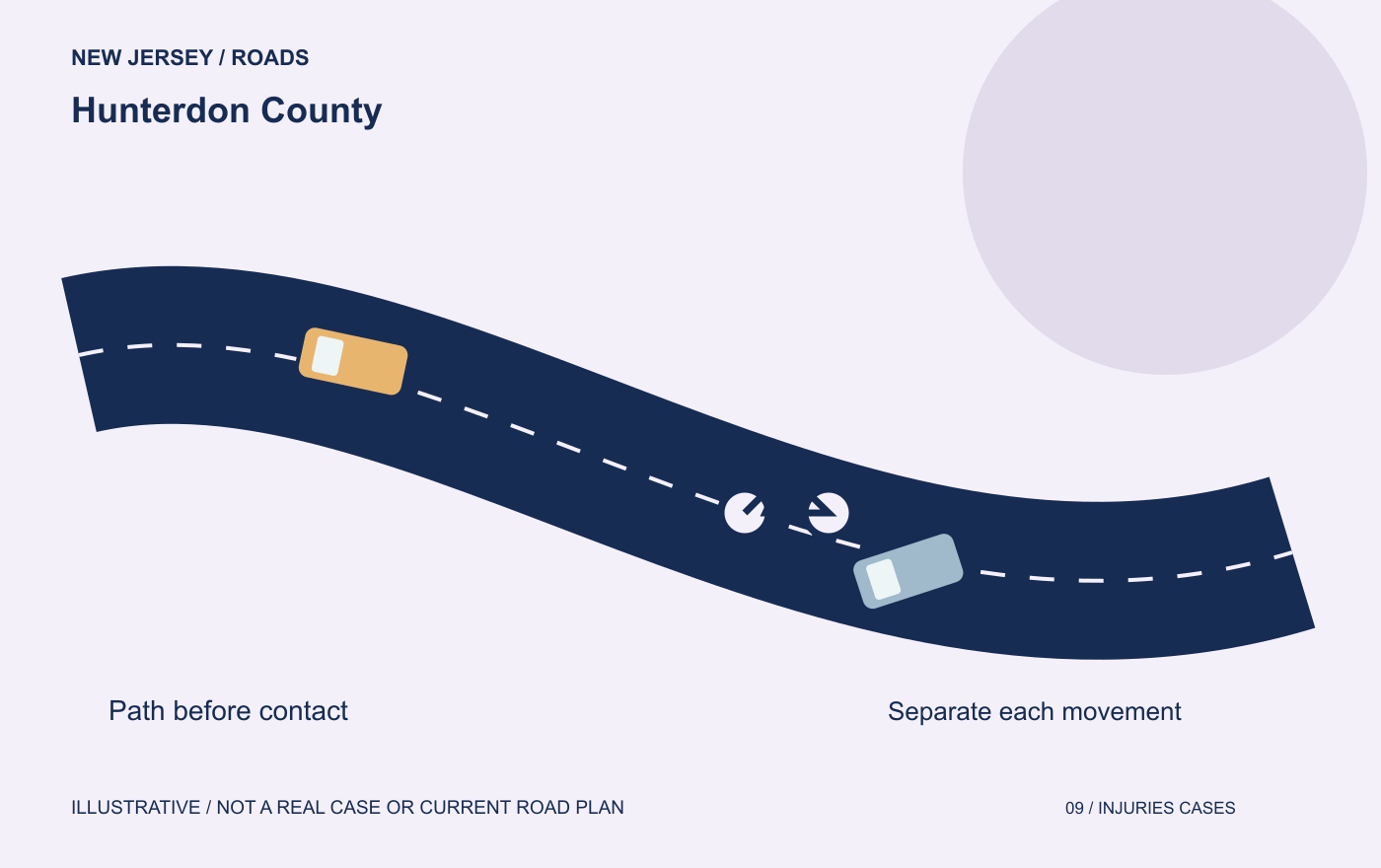
Consider a hypothetical situation in which a car moves from an inner position across a rider's path toward an exit. Compare that with a car that begins entering while the rider is already passing the entry point. These illustrations involve another driver, but they do not share the same sequence or visibility question.
If you saw the car's signal, say when you first noticed it. Do not infer that it had been operating for the whole approach. If no signal was visible from your position, explain that limitation rather than claiming there was definitely none anywhere on the vehicle.
The car crosses before you can clear its side
When a car's side or front corner moves toward your motorcycle, the available space can change quickly. Describe whether the car first contacted your front wheel, leg area or another part of the motorcycle, if you know. If the motorcycle then fell, distinguish that later movement from the original vehicle contact.
Do not conclude that damage at one point proves the whole event. A motorcycle can move after the first contact, and a rider may have a limited view during the impact. Preserve photographs of the motorcycle as a whole as well as the affected areas. Tell a reviewer which details you remember and which you learned by looking at damage later.
If you were riding with a group, ask each person to describe their own view. A rider behind you may have seen the car's lane movement but not its signal. Someone ahead may have heard the collision without seeing how it started. Those differences help define the evidence rather than make the accounts worthless.
Keep the local rule separate from the disputed movement
An exiting car may cross the rider’s line before it reaches the exit; an entering car can create a conflict at a different stage. Describe those paths separately. County directions identify the circles along the journey. They do not establish current lane geometry, protected phases or a universal yielding order.
Care and the next useful conversation
Call 911 for an emergency or an unsafe scene. Seek medical advice for injuries and follow the treating clinician’s instructions. Do not stop on an active road or ramp to reconstruct a collision.
For treatment payments, work losses, coverage and proposed releases, use the focused guides: New Jersey motorcycle accident help; An injured passenger’s separate questions.