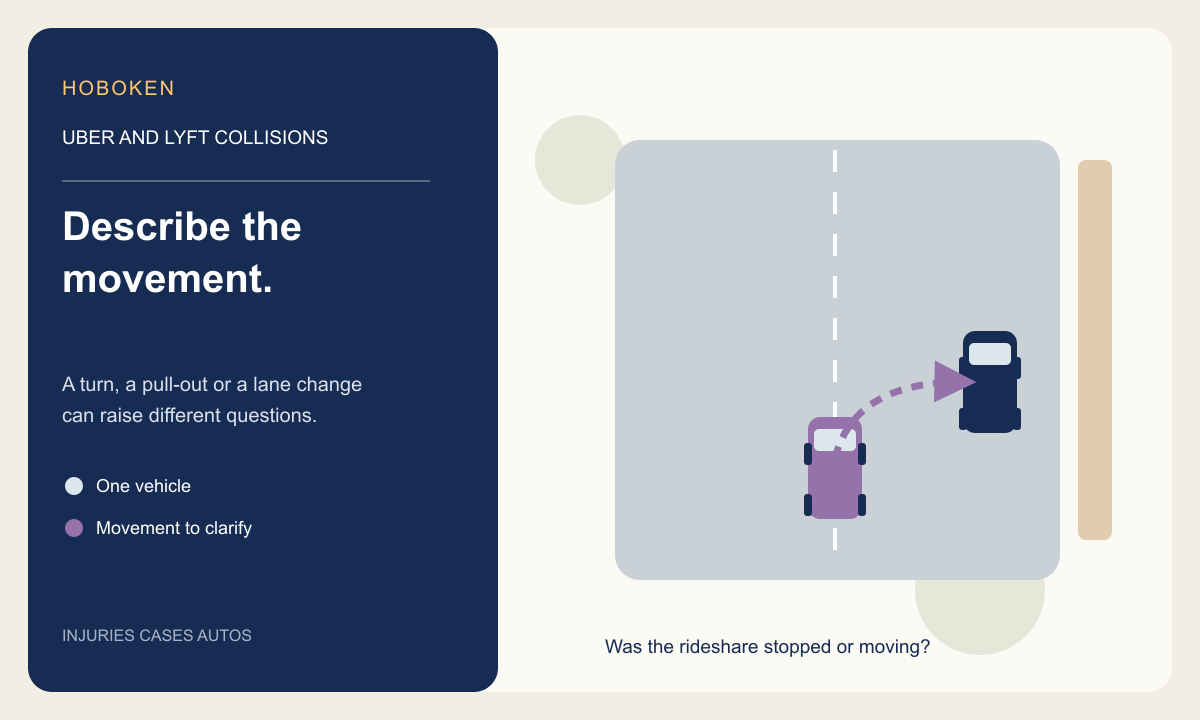
Washington Street: stopped, pulling away or still boarding?
Hoboken's September 2025 Washington Street account describes blocked lanes and views. It does not identify every stopped car as rideshare or determine the drivers in your event.
| Your position at impact | The timing question | What your own account can add |
|---|---|---|
| Seated in a stationary ride | Had the passing car arrived beside it before either vehicle moved? | Side contacted, seat occupied and whether you saw the approach |
| The ride began pulling away | Was the other car already alongside when the pull-out began? | First movement you noticed, driver message and original recording if available |
| Still entering or leaving | Was your body inside, beside the door or already on the pavement? | Boarding stage separate from app start/end time |
These are observation prompts, not a current street diagram. The actual curb controls and vehicle positions need their own review.
This section uses the linked official resources checked on October 13, 2026. It is an editorial comparison, not original crash data or a finding about your case.
Why does Washington Street double parking matter?
Hoboken's September 2025 CLEAR announcement described blocked travel lanes and obscured views associated with illegal parking on Washington Street, between Observer Highway and Eighth Street. The city specifically noted that motorists can be forced around double-parked vehicles. Hoboken's Washington Street safety account
That is a real local traffic problem, but the announcement does not identify every stopped vehicle as an Uber or Lyft. A private car, a delivery vehicle and a passenger pickup can create different situations. Your article, statement or claim should identify the actual movement rather than assigning every parking problem to one industry.
For an injured passenger, the question may be whether another driver struck the stopped rideshare, whether the rideshare driver pulled into another vehicle's path or whether a third vehicle forced a sudden manoeuvre. The street context matters because it helps explain those positions.
What happens when a driver tries to get around a stopped car?
Picture an occupied rideshare waiting near the curb while another driver moves out to pass it. A collision can occur when that vehicle returns to the lane, when the rideshare begins moving or when traffic approaches from another direction. That is an example of a conflict to investigate, not an account of a particular Hoboken case.
Explain whether your car was stationary and when it began moving. If you saw another vehicle alongside it, describe where. If the view was blocked, say that rather than making a precise account of a manoeuvre you could not see.
The city’s safety account supports concern about blocked sightlines. It does not establish which driver was responsible for your impact. A person who parked badly and a person who drove into an occupied vehicle may each need investigation; the actual facts determine the assessment.
What if you were injured while getting into or out of the rideshare?
Describe the stage of the pickup or drop-off. Were you seated, still entering, standing beside the car or already on the pavement when another vehicle made contact? Those are different sequences, even when they occur within a few seconds.
Retain the driver messages and trip record. If the driver instructed you to meet somewhere other than the original app pin, explain that. The booking map alone may not describe where the car actually stopped.
Do not assume the app ending a trip decides what insurance applies to an earlier impact. The timeline and relevant policies need review. A lawyer can consider those questions while you focus on medical care and the changes the injury has caused.
Which stopped vehicle blocked the view?
Identify the stopped vehicle, the side on which another vehicle passed and your position when you first saw the approaching traffic. Distinguish your rideshare pulling away from a passing driver moving alongside it. A Washington Street pickup location or curb programme does not prove which vehicle obscured the view in your collision. Keep existing approach footage if available, without treating a later empty-street photograph as the collision-time view. Use statewide rideshare guide for the broader claim.
What if the crash followed a pickup near Hoboken Terminal?
Distinguish the pickup from the collision. A receipt labelled Hoboken Terminal does not mean the impact happened at the station or immediately beside it. Your trip may have continued along other streets before another driver hit the car.
Describe whether the driver was still positioning for pickup, leaving the stop or travelling normally. That helps separate a curbside conflict from a collision later in the ride. You do not need to invent the legal status of a stopping place to explain the movement you experienced.
If someone else booked the ride, ask them to keep the receipt and messages. The booking holder and injured passenger can be different people. Make that clear at a consultation so your account and the app record can be considered together.
Does it matter which driver caused the impact?
Yes. Treatment-payment questions and responsibility for the collision are separate. Describe whether the rideshare pulled out, another vehicle passed it or both moved before contact, and keep your observation limits clear. A platform name or support acknowledgement does not decide responsibility. Use statewide rideshare injury and insurance guide to separate the investigation from the policies being reviewed, without assuming one driver alone caused the injury.
How do you handle injuries and treatment costs?
Seek medical advice about symptoms and limitations. Explain how the vehicle was struck and whether you were inside or entering it. Call 911 for an emergency. An app support conversation is not an assessment of your condition.
Ask how available insurance is being considered for your circumstances. The way a treatment bill is paid and the evaluation of a liability claim may be separate discussions. Keep any offer or release so the person advising you can examine its actual wording.
If you cannot do your usual work, tell your clinician what the job requires. Sitting through a shift, lifting, driving and caring for someone at home may involve different restrictions. An accurate description of daily impact is more useful than predicting a settlement from another passenger's headline.
What should you ask a Hoboken rideshare accident lawyer?
Ask how the trip timeline and other driver's movement will be established, which policies need review and how continuing symptoms affect an early offer. Ask who will handle the matter and how fees and case expenses work.
Bring the information available, including messages, an original recording and any proposed agreement. Explain the urgent question first. A useful consultation should address the collision and your injury, rather than make you start by researching parking enforcement procedures.
Advertisement: Start the New Jersey accident quiz. It opens in English. Injuries Cases Autos supplies general information and is not a law firm. No representation or result is guaranteed.