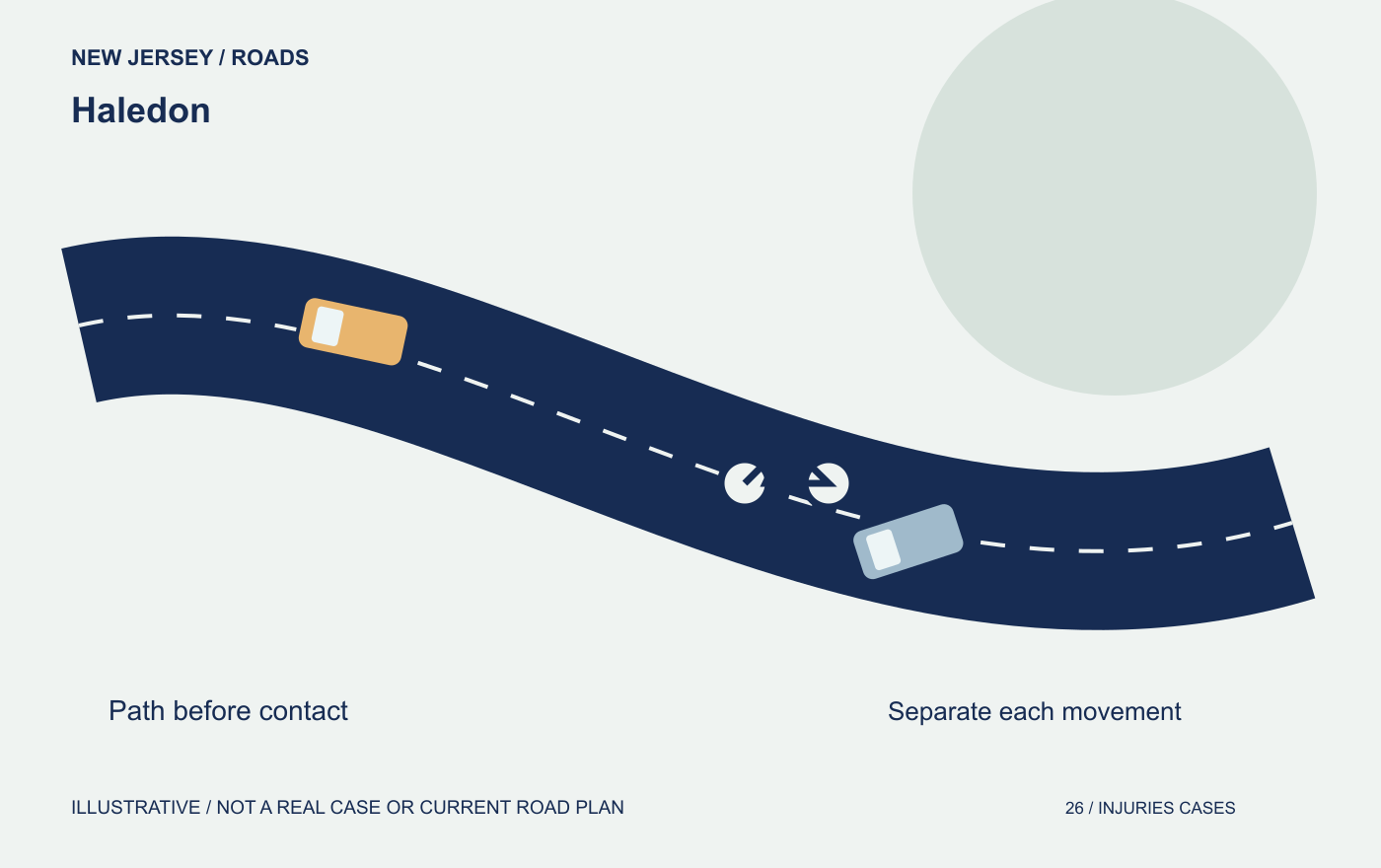
Haledon's junction list is not a signal-phase plan
Church Street between Belmont and Haledon has a specific approach-direction entry in the borough schedule. If the car originated on Church, explain where it began and whether it was already entering Haledon. A turn beginning from Belmont presents a different origin, even if the motorcycle later came to rest near Church.
| Local reference | Published provision | Movement limit |
|---|---|---|
| Haledon at Belmont; Haledon at Church | Section 205-20.1 lists two signalised junctions. | No protected-left phase, cycle timing or collision signal shown. |
| Church between Belmont and Haledon | One-way schedule labels east, toward Haledon Avenue. | Do not apply that bounded Church segment to every surrounding road. |
| First conflict versus landing | The motorcycle may travel beyond the initial vehicle conflict. | The later resting point does not identify which junction origin was involved. |
Source check: October 13, 2026. Haledon Section 205-20.1; Haledon Section 205-24.
Describe the car's turn from its starting position
If you saw the car approaching from the opposite direction, describe where it began turning. If it came from a side approach, name that approach when you know it. A vehicle crossing your direction and a vehicle turning into your direction create different points where the paths may meet.
In a hypothetical example, a car turns left across an approaching motorcycle while the rider continues toward the junction. In another, a car completes a turn, then changes position into the rider's lane. Both involve another driver, but the second example needs attention to the movement after the turn. Neither is an actual Haledon case.
If the car was obscured until it moved into view, say what blocked your view and when you first saw it. You do not need to invent its earlier position. Your account can be useful while clearly identifying the part you did not witness.
What did you do when the car moved?
Explain whether you braked, changed direction or had no time to react. Include your own movement even if you believe the turn created the danger. A complete account can help distinguish the space available before the car entered from the space available afterward.
If another driver claims you were speeding, ask what supports that statement. A sudden appearance of a motorcycle is not a measured speed. Equally, your own estimate may have limits if you were watching the junction rather than the instrument display. Identify the evidence and avoid converting either person's impression into a verified number.
If you had just changed lanes or passed another vehicle, explain where and when. Do not omit an earlier movement because the turning car seems more important. The reviewer needs the sequence that brought both vehicles to the conflict point.
Keep the local rule separate from the disputed movement
If the motorcycle travelled beyond the initial vehicle conflict, keep the landing point separate from the car’s original approach. Use the bounded Church segment only if that is where the car began its movement. The signal-installation provision does not show a protected turn, the actual phase or the indication facing either driver.
Care and the next useful conversation
Call 911 for an emergency or an unsafe scene. Seek medical advice for injuries and follow the treating clinician’s instructions. Do not stop on an active road or ramp to reconstruct a collision.
For treatment payments, work losses, coverage and proposed releases, use the focused guides: New Jersey motorcycle accident help; An injured passenger’s separate questions.