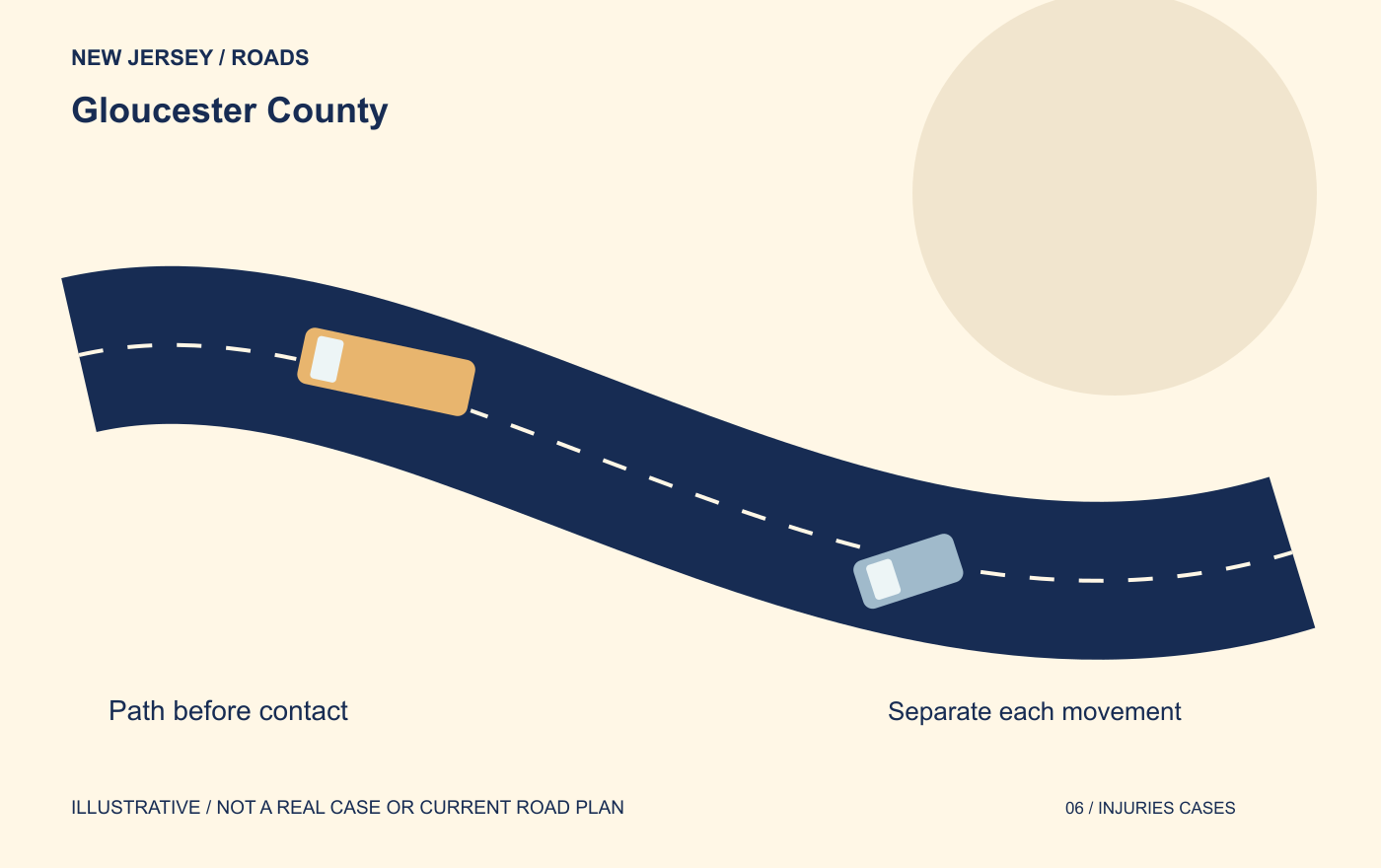
Separate the Route 55 mainline from the Route 322 connection
Do not choose a ramp letter from a remembered Glassboro or Mullica Hill destination. A Route 322 trip and contact on Route 55 can refer to different points. Give the highway direction, entering road and first observed truck movement before a reviewer compares ramp-specific records.
| Location or path | Official locator support | Collision question |
|---|---|---|
| Route 55/Route 322 area | NJDOT's 2019 route diagram shows the US 322 connection in the 50 to 53 milepost sheet. | Which direction was each vehicle travelling? |
| A ramp from Route 322 | The diagram includes a US 322 eastbound to Route 55 southbound ramp label. | Was the truck joining the highway or were you entering beside it? |
| An exit from Route 55 | A different vehicle path from joining Route 55. | Was first contact before the truck or car reached the ramp? |
| Trailer already beside the car | Your observation, not an exit-number inference. | The tractor and trailing part may reach different positions at different moments. |
Source check: October 13, 2026. NJDOT Route 55 road inventory, March 2019.
Was the truck joining, leaving or already alongside you?
Start your account one movement before the impact. Were you traveling north on Route 55, coming from Route 322 eastbound or preparing to leave Route 55 for Route 322? Then describe what you directly observed about the truck. Seeing its turn signal, tractor wheels or trailer side is different from knowing where its driver intended to go.
An illustrative situation is a car entering Route 55 while a truck already on the highway moves toward an exit. Another is a truck entering while a car ahead slows to leave. These are hypothetical situations, not accounts of local cases. Each raises a different question about who occupied the disputed space first and how each driver could see the other.
If you cannot remember which ramp you used, say so. A photograph of an exit sign or the route in your navigation history can help reconstruct the approach. Do not turn a later reconstruction into a claim that you remember every lane marking.
The tractor clears your car, then the trailer makes contact
The first part of a truck can pass without touching your vehicle while the trailer remains alongside it. If that happened, explain whether your car was still moving, braking or already stopped when contact occurred. State which part of the trailer you saw and which part of your car was damaged.
A scrape beginning near your front door and damage confined to a rear corner are different observations. Neither automatically proves accident fault. They can help a reviewer test competing descriptions against vehicle positions. Keep photographs that show the whole vehicle as well as close views of damage, because a cropped image may hide where that damage sits.
Do not estimate a truck's blind spot or claim the driver could not see you simply because the vehicle was large. Describe whether you could see its mirrors and whether it was already beside your car. Questions about visibility, trailer tracking and available space need the actual vehicles and collision sequence.
Keep the local rule separate from the disputed movement
The dated route inventory supplies a connection locator. It does not establish a present ramp letter, taper length or lane arrangement. Separate a truck joining the highway, a truck leaving it and a truck already travelling alongside you. The conceptual comparison does not prescribe a yielding order.
Care and the next useful conversation
Call 911 for an emergency or an unsafe scene. Seek medical advice for injuries and follow the treating clinician’s instructions. Do not stop on an active road or ramp to reconstruct a collision.
For treatment payments, work losses, coverage and proposed releases, use the focused guides: New Jersey truck accident help; Describing several vehicle impacts.