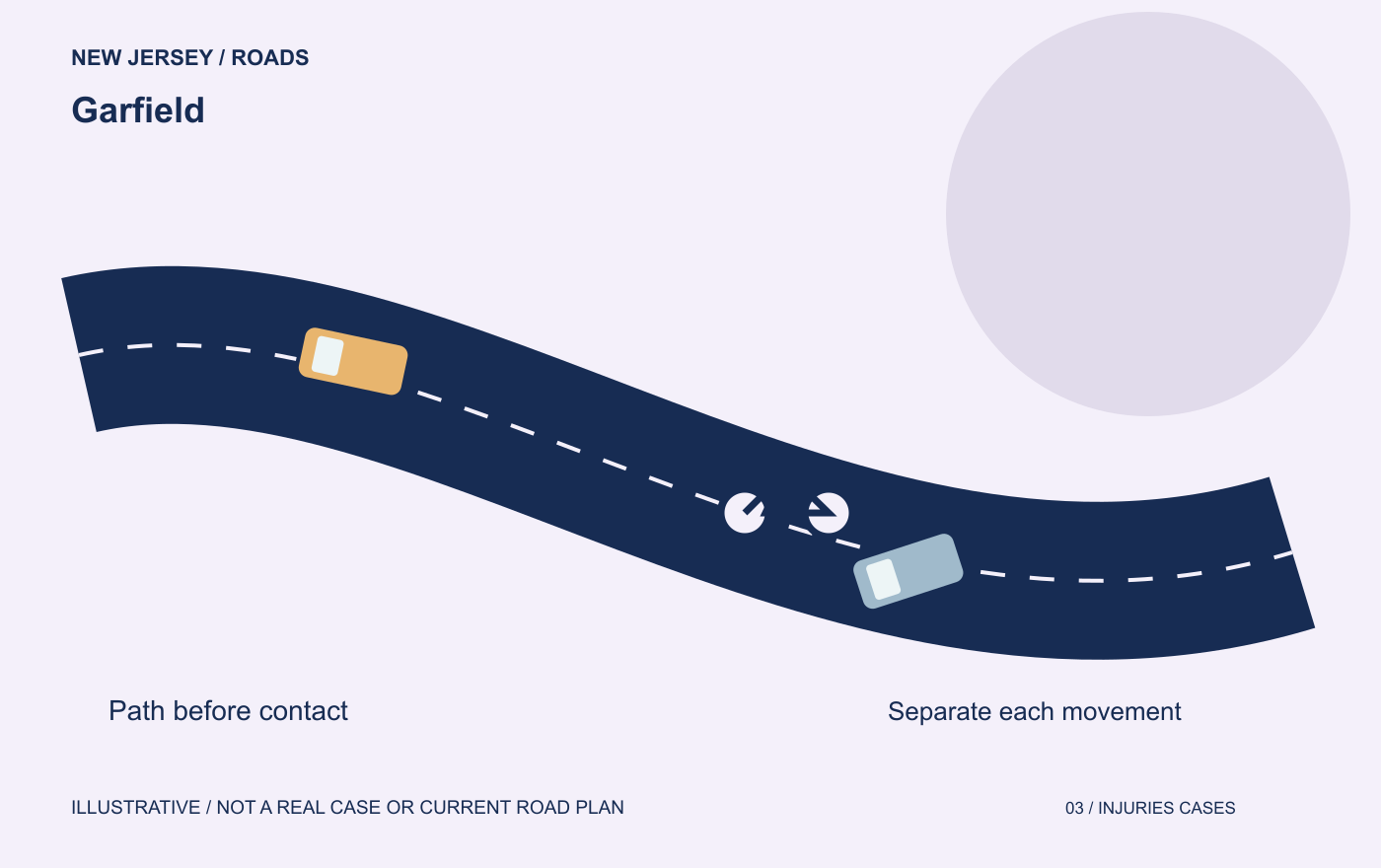
Place the turning car on the correct side of the bridge
A trip into Garfield may begin on the Clifton bridge approach. If the car entered from a street or driveway after the crossing, identify that origin rather than assigning the whole trip to the bridge. The actual first conflict decides which location detail is useful.
| Landmark | Municipal source establishes | Collision observation |
|---|---|---|
| Veterans Bridge | Connects Ackerman Avenue in Clifton with Outwater Lane. | Whether the first conflict began before or after the bridge crossing. |
| Outwater Lane/River Drive setting | Identified by Garfield's city history. | Junction turn, bridge approach or a property pull-out. |
| A retail entrance nearby | A road/property name alone does not locate an opening. | The actual origin seen before contact, without naming unverified tenants. |
Source check: October 13, 2026. Garfield municipal bridge locator.
A junction turn or a property pull-out?
Imagine two hypothetical situations. In one, a motorist turns at River Drive while a rider approaches along Outwater Lane. In the other, a car leaves an entrance along the rider's road and moves into the motorcycle's path. These are illustrations, not actual local cases.
Explain whether the car began on another street, in a driveway or already in the same road as the motorcycle. If you are uncertain which property it came from, say so. A familiar retailer nearby does not prove the driver had been visiting it.
The driver's stated destination may clarify their intended turn. It should be kept separate from the movement you observed. Someone investigating needs the starting point and crossing path, including where your motorcycle was when the car began moving.
If you saw a signal or sign, explain that observation without assigning a rule from a map alone. The current controls and their relevance to the movement need verification.
A right-turn entry into the rider's direction of travel
A car can enter the motorcycle's path without crossing the whole road. If it turns into the same direction of travel, the relevant questions include the gap, the rider's position and whether the car continued moving into the occupied space.
Explain whether contact was at the bike's front, side or rider's body, and whether the car was still turning. Do not assume a right turn was harmless merely because both vehicles were then pointing in the same direction.
If the motorist accelerated or slowed immediately after entering, describe what you observed. You do not need to estimate exact acceleration, speed or distance to give a useful sequence.
The fact that the motorcycle contacted the car does not independently settle how the conflict began. The entry and the approach still need examination.
Keep the local rule separate from the disputed movement
If contact began on the Ackerman Avenue approach in Clifton, identify that before using a Garfield junction reference. If the car originated near Outwater and River after the crossing, name the street or opening you actually saw. Do not assume a currently open business entrance or conclude that the bridge caused the collision from the trip route alone.
Care and the next useful conversation
Call 911 for an emergency and seek medical assessment after the collision. Tell the clinician whether a car struck the motorcycle or your body, whether you fell and what you contacted afterward.
For treatment payments, work losses, coverage and proposed releases, use the focused guides: New Jersey motorcycle accident help; An injured passenger’s separate questions.