Use Elmwood Park's own vehicle criterion
A truck can be empty and still have a gross vehicle rating above the stated threshold; an onlooker's cargo estimate cannot answer a rating-based question. Ask which official vehicle specification is being used to identify the rating. You do not need to publish or collect the driver's personal details to frame that question.
| Local movement | Criterion in Section 7-23(a) | Evidence to distinguish |
|---|---|---|
| Midland Avenue South onto Industrial, right turn | Gross vehicle rating over 15 tons. | Rated specification, not guessed loaded weight. |
| Industrial Avenue East onto Midland, left turn | The same rated-over-15-ton criterion. | Starting road and approach, not merely a delivery destination. |
| Nutley comparison | Nutley uses a different registered gross weight test and local exceptions. | Do not import its four-ton threshold or delivery exception here. |
Source check: October 13, 2026. Elmwood Park Section 7-23(a); Nutley weight provision for comparison.
Was the truck entering Industrial or leaving it?
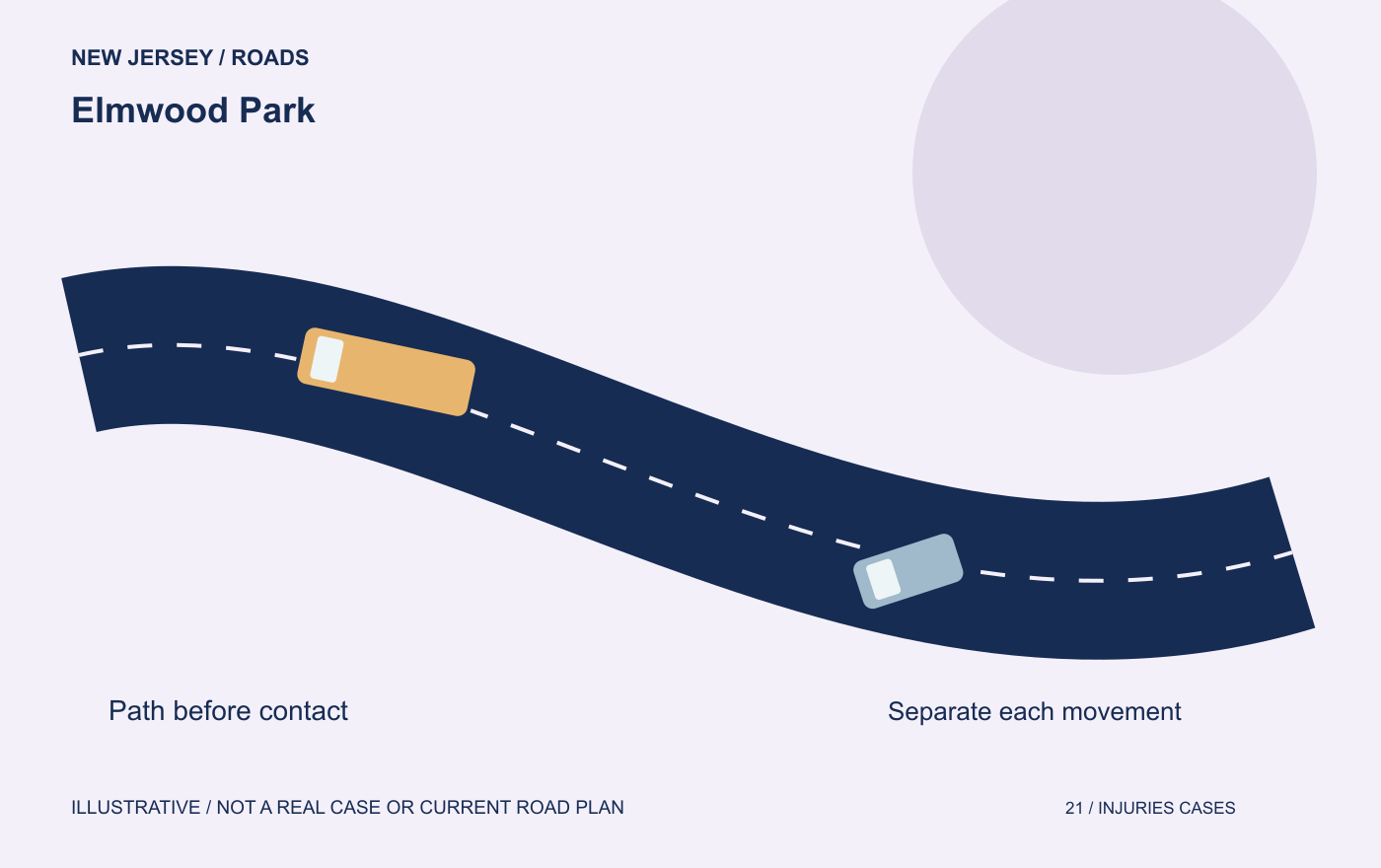
Describe the roadway the truck occupied before it began turning. A hypothetical truck approaches along Midland and turns toward Industrial while another vehicle is close to its side. A different hypothetical truck begins along Industrial and turns toward Midland. These are illustrations, not reported Elmwood Park cases.
The same junction name can describe both events, but the driver's original view and the space the truck enters differ. State which direction you observed rather than choosing one from where the vehicle ended up after impact.
If you only noticed the truck during the final movement, say so. You can describe what reached your car without claiming to know the entire approach. A passenger or recording may help identify an earlier position that was outside your own view.
Contact during positioning before the turn
The truck may move sideways before it reaches the junction. If it contacted you while getting into position, explain where your car was when the movement began. Were you established beside the truck, approaching behind it or moving into a neighboring space yourself?
If you saw a turn signal, describe when you noticed it and what movement followed. A signal can help explain an intention while leaving the available clearance unresolved. If your own car was changing position, include that movement and timing too.
Do not move the point of contact to the intersection just because the driver intended to turn there. A lane change before the junction, the turn itself and a later stop can be different parts of the event. A review needs their sequence rather than only the final arrangement.
Keep the local rule separate from the disputed movement
The cited Elmwood Park paragraph does not state the materials-delivery exception found in Nutley's provision. That does not decide whether some other law or collision-date amendment applies. It means this article should not add a delivery exemption to this particular paragraph. Separate permission for the turn from the actual clearance and movement beside your vehicle.
Care and the next useful conversation
Call 911 for an emergency or an unsafe scene. Seek medical advice for injuries and follow the treating clinician’s instructions. Do not stop on an active road or ramp to reconstruct a collision.
For treatment payments, work losses, coverage and proposed releases, use the focused guides: New Jersey truck accident help; Describing several vehicle impacts.