Airport passenger: position first, travel plan second
The airport's ground-transport page identifies curbside rideshare. Its official address is in Egg Harbor Township; a downtown Atlantic City destination does not relocate an airport impact.
| Your immediate situation | Information to explain | Next useful question |
|---|---|---|
| You were seated but another person was loading bags | Each person's position at impact | Who saw the passing car and who felt the pull-out? |
| You were still entering | Door, body position and whether the ride had moved | Which medical history describes that individual position? |
| You will return home before follow-up | Actual treating information and travel date | Ask the treating clinician what follow-up and information handoff are appropriate. |
Do not delay care to complete app screenshots. A missed flight or trip refund does not diagnose the injury or settle an injury claim. The insurer still needs the actual passenger and trip circumstances.
This section uses the linked official resources checked on October 13, 2026. It is an editorial comparison, not original crash data or a finding about your case.
Atlantic City airport pickup is not a downtown casino stop
Atlantic City International Airport's official information says taxi, rideshare and car-share services are accessible curbside, and identifies Uber and Lyft as available rideshare services. Its contact address is in Egg Harbor Township. Airport ground-transportation information and official airport contact page.
Those facts distinguish the airport setting from a pickup in central Atlantic City. They do not establish a particular bay, stopping position or collision. If the booking says Atlantic City airport, explain where the car actually stood and whether it had left the terminal approach when contact occurred.
The airport also distinguishes rideshare from car share. A rented or shared car driven by you is a different arrangement from a prearranged ride with another driver. Tell the person assessing your injury which service you were using rather than describing every app-booked vehicle as Uber.
Why visitors may be relying on someone else to drive
If someone else booked your airport or hotel ride, ask them to keep the booking while you record who was actually in the vehicle. Distinguish waiting at the curb, loading luggage, boarding and being seated when contact occurred. A flight arrival or hotel destination does not establish the collision location or either driver's movement. Use statewide rideshare guide for the broader claim questions.
A passing car hits the occupied rideshare
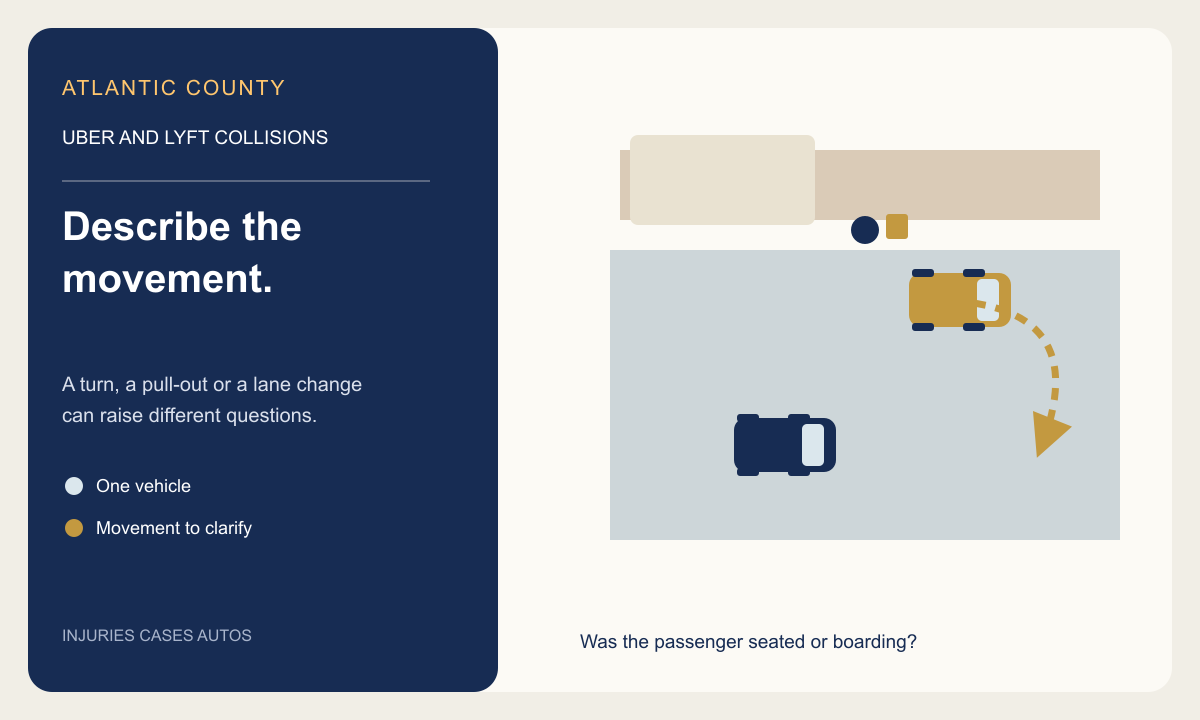
One hypothetical sequence begins with a rideshare stationary at the curb while another car passes and makes contact. Another begins with the rideshare pulling away while the passing vehicle is already alongside. These are illustrations, not actual local cases.
Explain whether your driver had begun moving before the impact. If you were still reaching for the seat belt or placing a bag down, describe that timing. If the car had already joined the lane, say what you remember about the period before contact.
The side of the car you used for boarding can help orient the account. You may not know its distance from the curb, but may remember which door was nearest passing traffic. Avoid giving measurements you never made.
A passenger should not be required to decide immediately whether the passing motorist was too close or the rideshare moved unsafely. Those explanations need to be tested against the sequence, available views and relevant controls.
Boarding and luggage can affect what you saw
If another member of your group was still loading bags when the vehicles collided, explain where they were. A seated passenger, a person beside the trunk and someone still entering the door may have different observations and injuries.
Keep each person's position separate. Do not describe everyone as a rear-seat passenger if that was not true. If another person booked the trip, retain the confirmation while identifying who was in the vehicle and who was injured.
You may have been looking toward luggage or the terminal rather than traffic. State that limitation. Someone investigating can compare your account with a driver, companion or recording, rather than relying on an apparently complete account built from guesses.
The trip record may identify the driver and car. It cannot independently establish where every passenger stood or which vehicle moved first. Physical observations and app information serve different purposes.
When the ride record and driver's description disagree
The driver may say the ride had not started, even though you had boarded, or that the app was already recording the journey. Ask which trip stage is being assessed and what supports that conclusion. Avoid treating one timestamp as an answer to every coverage issue.
New Jersey MVC describes transportation network companies as connecting riders and drivers through a digital network and explains that prearranged rides are subject to safety and insurance requirements. NJ MVC rideshare information.
For an injury claim, ask which policies are being considered for the rideshare and the other vehicle. If an insurer disputes the trip stage, bring the relevant confirmation or messages to the consultation. A platform support response and an assessment of injury coverage may address different issues.
Do not assume a trip refund resolves the collision. Establish what any payment or agreement means, who it covers and whether it includes a release of injury claims.
Getting care while away from home
Call 911 for an emergency and seek medical advice after the collision. Tell the clinician the impact sequence, where you were sitting or standing and the symptoms you have. Explain if travel plans make follow-up difficult.
If you will return home soon, ask the treating professional about follow-up and how to obtain information needed for the next clinician. Treatment decisions should reflect your condition. They should not be delayed solely because the trip was short or a driver described the contact as minor.
Keep the travel issue distinct from the medical issue. A missed flight, changed hotel stay or interrupted holiday may be part of the factual account, but it does not diagnose an injury or establish what losses are recoverable.
If your symptoms change after you return home, discuss that with your clinician. Be accurate about what changed, when it changed and how it affects normal activities. Continuing an honest treatment history is more useful than trying to match an online accident compensation figure.
Coverage questions for an out-of-town passenger
The payment route needs your actual policies and role in the collision. A local turn, road name or report does not decide medical-benefit eligibility. Use the statewide rideshare injury and insurance guide to separate treatment payment from responsibility; retain any written coverage explanation for individual review.
A practical Atlantic County rideshare consultation
Start with the terminal pickup, whether you were seated or boarding and the passing or pull-out movement. Explain that you are a visitor if that affects treatment, work or communication. Ask what information is time-sensitive and what can be assessed after you return home.
Bring any payment proposal, release and trip confirmation. Ask about fees, expenses and how continuing symptoms will be considered. You can begin with what you know, without proving the entire curb layout or choosing between the drivers' versions in advance.
Related guides: New Jersey rideshare accident help, Bloomfield rideshare accident help and Newark rideshare accident help.
Advertisement: Start the New Jersey accident quiz. It opens in English. Injuries Cases Autos provides general information and is not a law firm. No representation, compensation or outcome is guaranteed.