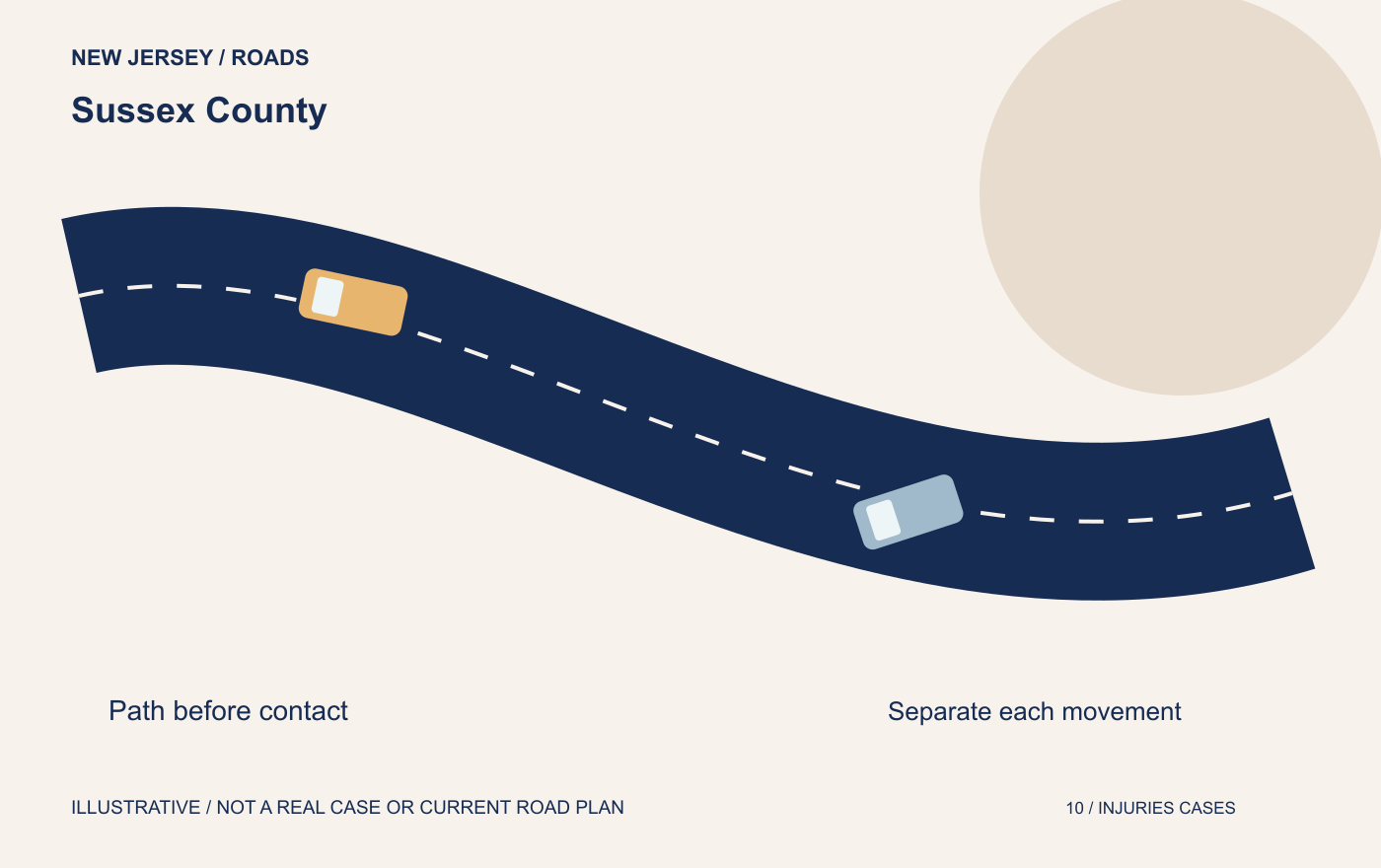
Name the Hamburg approach without borrowing an old construction layout
The route entries establish borough orientation; your account establishes whether the other car came from Route 23, Route 94 or another access. If you did not see its origin, identify the first point where it became visible. A turning-lane description from a historical project cannot fill that gap.
| Location reference | Current official route entry | Movement to establish |
|---|---|---|
| Route 23 in Hamburg | NJDOT lists the borough segment between Franklin and Hardyston. | Which Route 23 direction the car approached from. |
| Route 94 in Hamburg | NJDOT lists its Hamburg segment between Hardyston boundaries. | A Route 94 origin versus a nearby side-street origin. |
| Junction or side approach | Different starting positions can lead to similar final damage. | The first crossing or entry you observed, not a historic turning-lane description. |
Source check: October 13, 2026. NJDOT Route 23 Hamburg segment; NJDOT Route 94 Hamburg segment.
Did the car turn across you or enter beside you?
A turning car may begin on an opposing approach, while a car pulling from a side street starts elsewhere. If you only noticed the vehicle when it appeared beside a stopped queue, explain that limit. You do not need to decide its starting point before asking for help.
An illustrative collision is a car beginning a left turn while another car continues through the junction. A different hypothetical situation is a car entering around queued traffic near an adjoining street. Both involve another driver, but each presents different questions about visibility and the path to the point of contact. These are examples, not reported Hamburg cases.
Describe any signal, wheel movement or direction change you actually saw. A car ending up facing a particular street after impact does not necessarily show the direction it faced before impact. Keep photographs of the full scene and explain when they were taken.
The side street and the main junction are different origins
The historical NJDOT description mentions Linwood Avenue, Main Street and the planned Orchard Street extension around the project. Those names can help someone understand the area, but they do not locate a particular car without evidence. If a driver says they came from a nearby street, ask which one and where they entered your path.
A photograph of an opening or street sign may help distinguish it from the Routes 23/94 junction. If you took the photograph on a later visit, keep that date with it. Current access or markings may not match what was there when you were hit.
Do not force an account into an intersection-turn scenario if the evidence shows a pull-out farther along the road. Conversely, do not let a nearby business or street become the presumed origin simply because it is close to the damaged vehicles. The original approach matters more than a convenient label for the final scene.
Keep the local rule separate from the disputed movement
A turn across your direction and a right-turn entry alongside you need different starting paths. Draw the movement you observed, leaving missing portions unfilled. The conceptual comparison is not a current map of Hamburg, and the route references do not reveal a driver's signal or the arrangement on an earlier crash date.
Care and the next useful conversation
Call 911 for an emergency or an unsafe scene. Seek medical advice for injuries and follow the treating clinician’s instructions. Do not stop on an active road or ramp to reconstruct a collision.
For treatment payments, work losses, coverage and proposed releases, use the focused guides: New Jersey car accident help; PIP and medical billing.