Summit study: counted junction or modeled traffic volume?
The April 14, 2026 traffic memorandum, PDF page 3, explains its methods. It supports junction identification; it does not show the signal or turning driver in your collision.
| Study item | Evidence type | Limit for your claim |
|---|---|---|
| Springfield Avenue and Maple Street | March 21 and 24 field turning counts | Counts are traffic observations, not crash findings |
| Summit Avenue with Union Place/Franklin Place | March 24 field turning counts | The exact car's movement still needs event evidence |
| Other studied junction volumes | Adjusted connected-vehicle estimates described in the memorandum | Do not call every volume a directly counted field observation |
The memorandum assessed a contemplated summer closure. It is not evidence that October traffic was following the same closure arrangement. Name the actual approach and date of your impact.
This section uses the linked official resources checked on October 13, 2026. It is an editorial comparison, not original crash data or a finding about your case.
Springfield Avenue and Maple Street are more than a title
An April 14, 2026 traffic memorandum prepared for the City of Summit studied the downtown network around Maple Street. It included turning counts at Springfield Avenue and Maple Street and at Summit Avenue with Union Place and Franklin Place, collected in March 2026. Other studied junctions included Springfield Avenue with Beechwood Road and Summit Avenue. Summit downtown traffic study.
These are identifiable places where several travel directions meet. For an injured occupant, the useful question is which approach each driver used. A statement that the other car came from downtown may leave out the junction entirely.
The memorandum assessed traffic operations for a contemplated summer closure. It is not a crash study, and its discussion of June through September does not establish an October closure. Explain the road conditions on your collision date rather than adopting an old diversion as current.
A turn across oncoming traffic
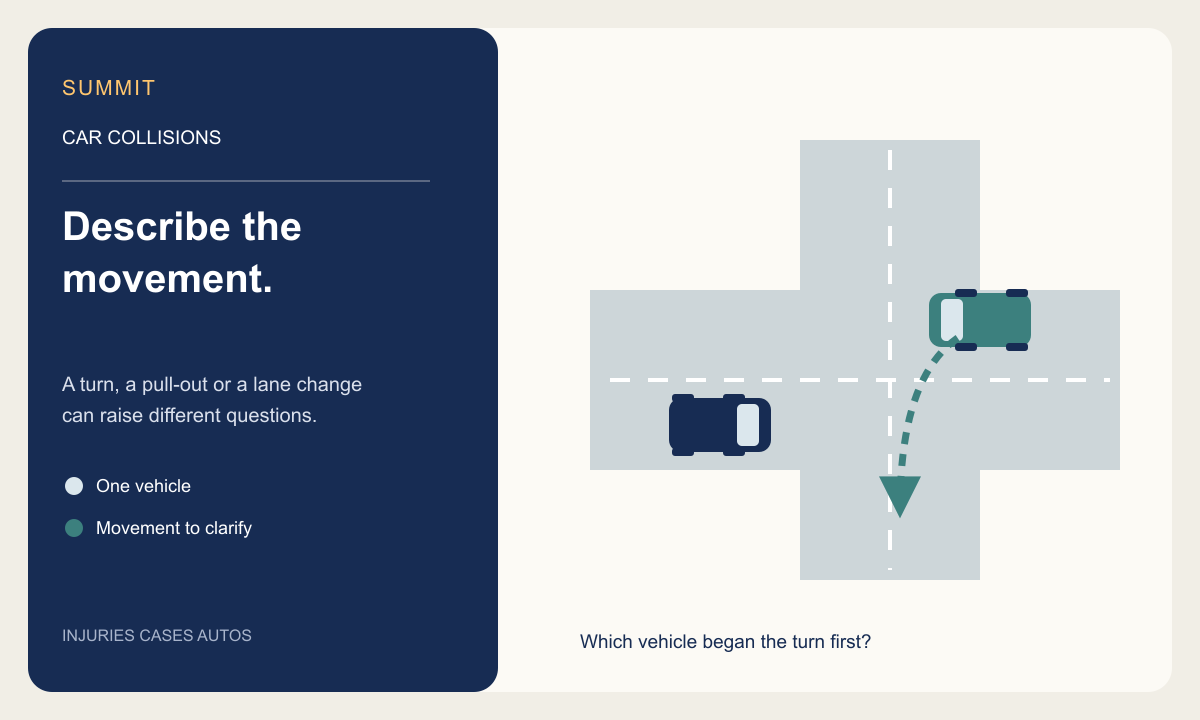
Take this hypothetical example: you continue along Springfield Avenue while an opposing driver begins a left turn. Contact occurs before the turning car clears your lane. The other motorist says they thought you were slowing for them. This illustrates a conflict to investigate, not a reported Summit case.
Describe your direction, the street the other driver was entering and where their turn began. If traffic in a neighbouring lane had stopped, explain that separately. A driver may interpret one open gap as permission to turn while overlooking another approaching vehicle.
Your account should distinguish what you saw from what the driver later told you. If you heard “I thought you were letting me go,” retain that wording accurately. It is still an explanation that needs to be assessed alongside the movements and available evidence.
A turn signal does not tell the whole story. The timing, approaching traffic and opportunity to complete the turn matter. Someone reviewing the collision needs those specifics rather than a general claim that downtown traffic is confusing.
When a car comes out from a side approach
A driver entering from Maple Street or another downtown approach may collide with a car already passing through the intersection. Identify which street you were on and which street the other vehicle came from. Do not infer a particular control or priority from a planning map.
If a signal was involved, state what you personally observed and when. A passenger watching a phone may know nothing about the signal but remember the impact and the driver's reaction. That is a valid limited account, without needing to agree with someone else's recollection.
The position of nearby vehicles can help explain visibility. Describe whether another car obscured the approaching motorist or whether the driver moved around a stopped vehicle before entering. The obstruction and the vehicle that struck you may be different vehicles.
An investigation should check the controls and markings applicable at that junction and date. A traffic study that lists an intersection does not establish which driver had permission to make the movement in your crash.
Side contact while someone changes their intended turn
Some downtown collisions occur because a driver changes direction while already approaching a junction. They may decide to turn, move around a stopped car or cross into another vehicle's space. Explain whether contact happened during the approach or inside the junction.
For example, an occupied car travelling straight may be struck by a motorist who begins turning from beside it. Alternatively, both cars may be turning while one changes position. These hypothetical possibilities call for different explanations.
If you were already alongside, describe how long that had been true without guessing an exact number of seconds. If your car was stationary, explain what you were waiting for. Final vehicle positions can hide an earlier change in direction.
The relevant evidence may include a dashcam recording or an independent view of the approach. Ask whether recordings exist and can be preserved. Do not assume a downtown business filmed the street or captured the correct signal.
If you were an injured passenger
A passenger injury claim deserves its own account. Say where you sat, which side was struck and whether your body contacted the door, window or another interior surface. Explain whether you were looking toward the junction before contact.
You do not have to adopt your driver's version to seek advice. If the driver changed direction and another vehicle contributed, describe what you know about both. A passenger should not be pushed into settling the dispute between drivers before discussing an injury.
If a friend or family member was driving, tell the person advising you. Ask how the claim will be assessed and whether any conflict needs consideration. The relationship does not replace an examination of the available facts and policies.
Pain after a downtown side impact
Call 911 for an emergency and seek medical advice after the collision. Describe the impact and your symptoms to the treating professional. The street's appearance or a driver's statement that they were moving slowly does not diagnose your condition.
If you cannot comfortably turn your head, sit through a shift or carry out normal tasks, explain the limitation accurately. Tell the clinician if symptoms change after the first visit. Avoid calling the injury a concussion, fracture or spinal injury unless that is supported by the medical assessment.
When discussing car accident injuries, keep actual effects separate from settlement expectations. A search for pain and suffering can help identify a question for a consultation; it cannot determine what your condition is worth.
Keep track of missed work and help needed at home. Describe the tasks you could not do and the reason. Someone else's recovery timetable should not become a prediction for your own treatment or return to work.
Treatment benefits and the right to sue are different questions
The payment route needs your actual policies and role in the collision. A local turn, road name or report does not decide medical-benefit eligibility. Use the statewide car injury and insurance guide to separate treatment payment from responsibility; retain any written coverage explanation for individual review.
Questions for a Summit car accident attorney
Start with the exact junction and the turning conflict. Ask how the investigation will test the competing accounts, including a claim that one driver waved or yielded. Ask what evidence would clarify the vehicles' positions before contact.
Then ask about treatment payment, work losses and the effect of any offer. If treatment is continuing or responsibility is disputed, explain that at the outset. An accident compensation estimate should not be based on a town name or an unrelated online case result.
Ask about fees, expenses and who will keep you informed. You can begin with an incomplete account while remaining clear about the gaps. A useful consultation should connect the downtown movement with your injury and practical choices.
Related guides: New Jersey car accident help, Denville car accident help and Morristown rideshare accident help.
Advertisement: Start the New Jersey accident quiz. It opens in English. Injuries Cases Autos provides general information and is not a law firm. No representation, compensation or outcome is guaranteed.