The destination and the accident location are different facts
'We were on our way to LBI' explains the trip, but it does not locate the collision. You might mean a mainland road before the crossing, part of the bay route or the streets after arriving. Begin by separating the destination from the road where the event happened. Write the last location you know and the direction you were traveling, even if the precise point is still uncertain.
NJDOT's Route 72 location page places the Manahawkin bridge corridor in Ocean County, with Stafford Township on the mainland side and Ship Bottom on the island side. That is useful geographic background. It is not a substitute for your own location details. 'Heading toward the island' and 'already in Ship Bottom' can lead to different follow-up questions. Keep them distinct instead of using LBI as a label for the entire journey.
Read the illustration as a setting, not evidence
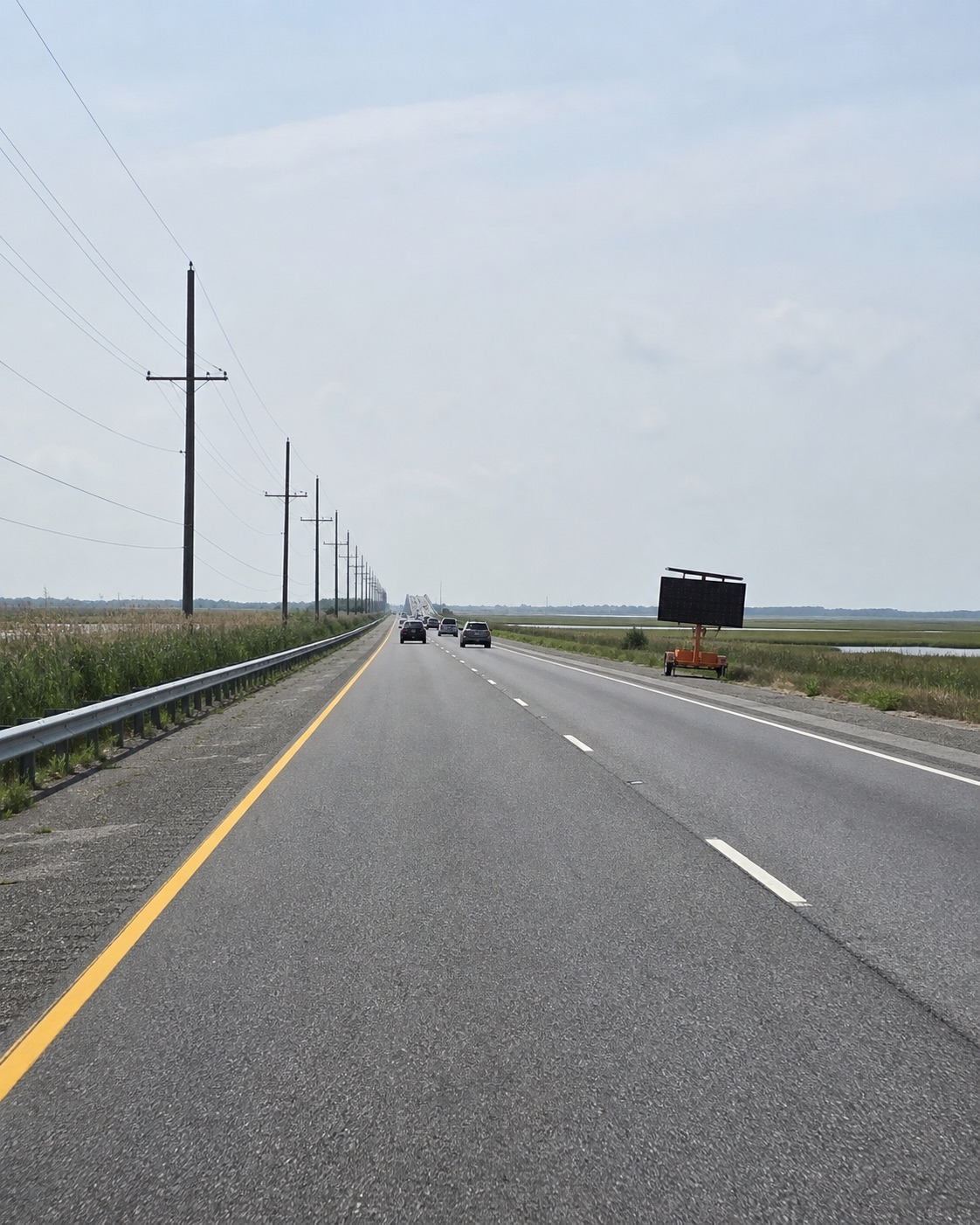
The generated image shows a road beside marshland, a guardrail, utility poles and a portable message board. It evokes a mainland approach toward a bay crossing. It does not document the road configuration on your accident date, and the dark board does not show a real traffic instruction. This distinction matters when an illustration resembles a familiar drive closely enough to feel like a photograph.
Use the picture to consider the context you remember: open ground beside the road, water, a barrier, an approach to a structure or traffic ahead. Do not borrow details you did not observe. If your accident happened in a built-up street after arrival, this marshland scene cannot explain its surroundings. Your file should be anchored to the actual stretch of the trip, while the article's image remains clearly labeled as an illustration.
Describe how traffic changed before the impact
A traveler may remember a smooth approach followed by a sudden queue, while another remembers moving slowly throughout. Neither description should be assumed just because the trip was to the shore. Record what you actually experienced: a gradual reduction in speed, stopping, starting again or a change in the space to the vehicle ahead. Avoid supplying a speed estimate if you did not observe one.
If several contacts occurred, describe them in order and identify which ones you saw or felt. A passenger could have noticed something outside the driver's view. Preserve that viewpoint as a separate account. The fact that people were traveling toward the same destination does not establish why anyone failed to stop or changed lanes. The useful record is the sequence, including the parts you do not remember clearly.

Keep the bridge, the approach and the island streets separate
Road names and local shorthand can make a conversation less precise. When you use 'causeway,' explain which part you mean if you can: before a crossing, on a structure or between recognizable points. If you only know the general corridor, say so. A sketch of the trip can show where your certainty ends without inventing a bridge name.
Historical NJDOT project pages describe the Route 72 link between Stafford and Ship Bottom. Their construction schedules are historical material, not evidence of today's closures. Do not use an old work notice to explain a recent collision unless its date and relevance have actually been checked. Likewise, the article does not assume a current number of lanes, a traffic-control arrangement or a particular construction stage. Your accident-date conditions are the issue to preserve.
Separate visibility observations from weather explanations
An open approach can leave a driver aware of light, sky and surroundings, but an accident account should avoid expanding a weather observation into a technical conclusion. If you remember glare, rain or reduced visibility, note when it affected your view and what you could or could not see. Do not assert a weather condition for the whole trip if you observed it only at one point.
Photographs may help show the light and scene when they were taken. Note whether that was before or after the event, and do not assume the conditions were identical. A forecast retrieved later can provide background but does not replace direct observations. If you cannot explain why visibility changed, preserve that uncertainty. The next person reviewing the accident can distinguish a remembered condition from an unsupported explanation of its cause.

Build a travel file without oversharing the holiday
A shore trip can generate receipts, accommodation messages and photographs unrelated to the accident. Do not send all of them just because they share a date. Identify what a record actually establishes. A receipt may show a purchase location; a booking may show an intended destination. Neither automatically proves where the vehicle was at the time of impact.
Keep useful records privately and retain their original form. Save a report number, any relevant insurer request and existing photographs in a dedicated folder. If a vehicle was towed or moved, record that separately from the collision location. Protect passenger information, booking references and personal addresses when discussing the accident. Before sharing a document, ask the recipient what it needs and use a verified destination. A smaller relevant file is easier to explain than an unfiltered holiday archive.
When you are back home, keep the contacts organized
The paperwork may continue after the trip ends. You might receive a call from one representative about the vehicle and another about documents related to medical coverage. Write the company, claim identifier and reason for contact beside each request. Do not assume that a request mentioning Route 72 should go into the same claim as every other message.
If a report is not yet in your possession, record the agency and any reference number you do have. Ask about the appropriate way to obtain or identify the record rather than guessing which agency handled it from the nearest town name. If a written document contains a location you believe is inconsistent with your notes, identify that discrepancy specifically. Keep your original account and any later correction dated, so the explanation remains understandable.
Finish with the question that remains unresolved
Once the route, sequence and documents are organized, choose the next question. It may be as practical as identifying the report agency or understanding where to send an estimate. It may concern coverage or legal rights, which calls for advice based on the actual facts and policy. You do not need a compensation estimate to begin that conversation.
This article cannot determine responsibility or establish whether a particular claim qualifies. The road to LBI is the setting, not a prediction about the outcome. Health concerns should receive appropriate care, and legal questions should be discussed with a qualified lawyer. A helpful first summary tells someone where you think the collision occurred, what you personally observed and what is still missing. It leaves room for investigation instead of forcing a complete story from incomplete information.