Route 37 is a location, not a complete description
After a collision, 'on Route 37 in Toms River' can be the first clear fact you have. It is a useful beginning, but it may not tell another person whether the event happened near a signal, in a turning movement, at a driveway or closer to the bay crossing. Those differences affect the questions that need asking, even before anyone discusses responsibility.
Write the direction of travel and the nearest cross street or feature you actually remember. If you know only that you were heading toward Seaside, say that and explain whether you know the compass direction. Do not choose an intersection from a map simply because it looks familiar. The aim is to locate the observation, not to attach a precise address to an uncertain memory. Keep the accident time approximate if that is all you can support.
Use the image to distinguish road features
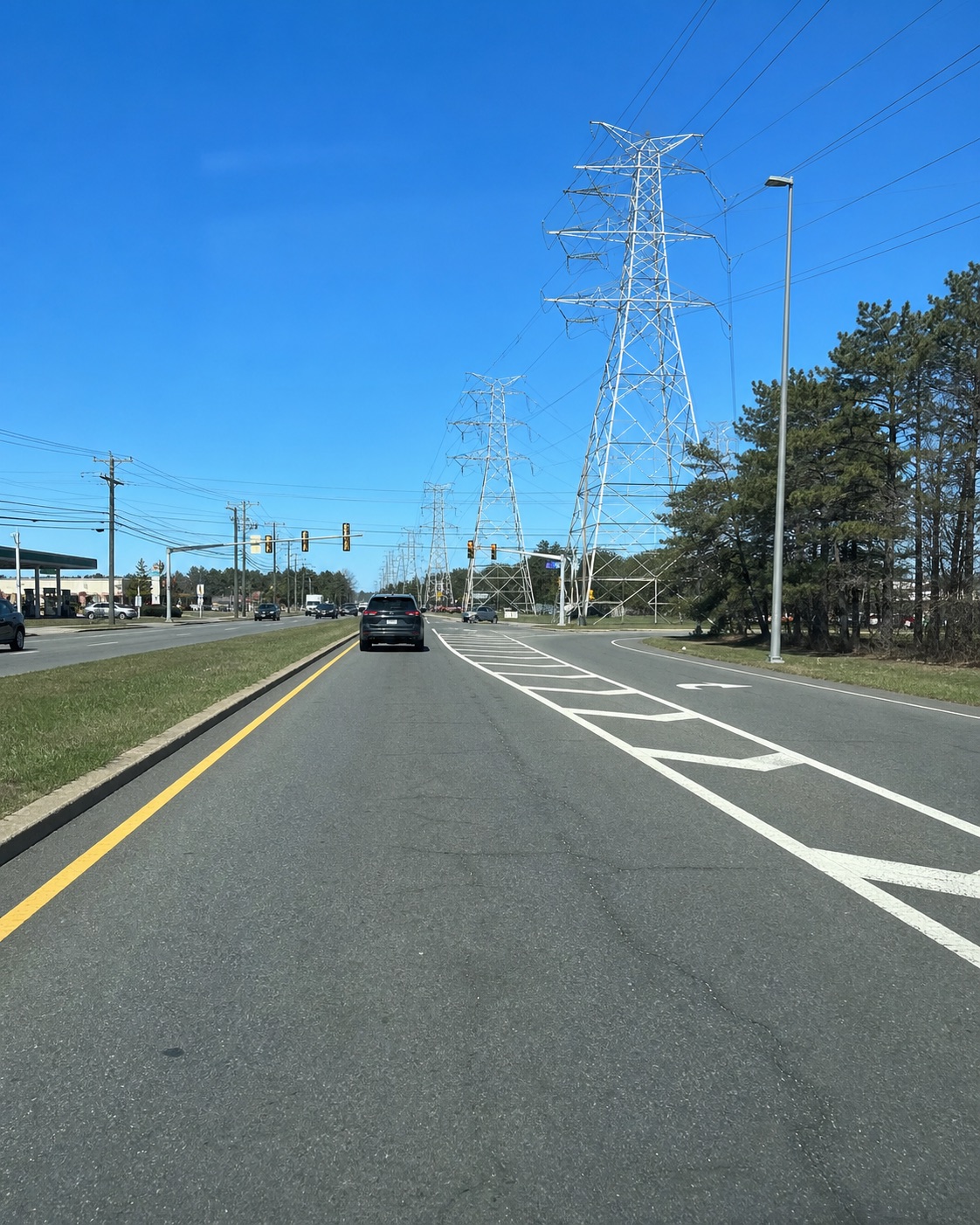
The illustration with this article contains a divided road, signals ahead, a striped area beside a travel lane and electricity transmission towers. It was generated from a description of local road character. It is not an exact map, an engineering drawing or a photograph of an actual crash. Its useful role is to prompt better descriptions of what appeared around your own vehicle.
For example, 'beside the striped area before the signal' is more specific than 'somewhere by the shops,' if that is what you remember. Do not infer a lane's permitted use from the illustration. Your accident-day signs, markings and observations are the relevant details. If a feature in the image differs from your recollection, your account should preserve the difference. There is no need to make the scene fit a picture selected for an article.
Identify the movement before the contact
A car slowing for a signal, a car leaving a driveway and a car moving toward a turn are performing different maneuvers. In your notes, describe your own movement first. Were you continuing straight, waiting, slowing or beginning a turn? Then explain what you actually saw the other vehicle do. A simple sketch can show relative positions without becoming a conclusion about who should have yielded.
Suppose you remember the other vehicle angled across your view but not where it came from. That uncertainty belongs in the description. Do not decide it must have left a particular business based on the damage alone. Similarly, a photograph of a vehicle near a driveway after the collision may not identify its position before impact. The movement and the final resting place need separate entries.

Keep signals and sight lines specific
People often summarize an intersection collision with 'I had the light.' Expand that only as far as your actual memory allows. Which signal did you see? Were you looking at it immediately before contact or earlier in the approach? Did another vehicle obstruct part of your view? If you did not see the signal controlling the other vehicle, avoid supplying its color from assumption.
Record visible conditions without turning them into a diagnosis of the crash. Glare, rain, another vehicle or a roadside feature may have affected what you could see. Their presence alone does not establish why someone collided. A passenger's account can help identify a different viewpoint. Keep that account attributed to the passenger rather than merging it with yours. A clear record can contain unanswered questions; it does not need to settle every disagreement.
Know when bridge background is relevant
NJDOT's Route 37 project overview identifies the Mathis and Tunney bridges as carrying the road over Barnegat Bay between Toms River and Seaside Heights. That gives useful geographic background for an accident nearer the crossing. It does not describe every collision on the mainland portion of Route 37, and its historical construction information should not be treated as today's traffic arrangement.
If the bridge approach matters, write whether you had reached it, were approaching it or were already beyond it. Keep any landmark specific. 'Near the approach' is not the same as 'on the bridge.' Do not add bridge details to a commercial-road collision simply because both happen on Route 37. This distinction can help someone looking at your file ask the right location question rather than beginning with an incorrect mental picture.

Gather the records that distinguish this particular trip
The most useful file contains records of your trip rather than generic pictures of the area. Save your original photographs, any available report number, correspondence and the documents already in your possession. If a passenger kept a contemporaneous message, preserve it privately. A message may help establish when someone reported the event, but its timestamp does not automatically establish the exact moment of impact.
If you have a towing or repair document, check how it labels the pickup or damage information. A pickup address can be where the vehicle was moved, not where the accident happened. Keep that distinction visible. Avoid uploading your full file to an unfamiliar website for a quick opinion. First confirm who will receive it and what specific item is needed. There is rarely a benefit to making private records publicly searchable.
Separate vehicle damage from health and coverage questions
A damaged bumper or panel is a record of visible vehicle damage. It cannot, by itself, tell you whether a person needs treatment. If you have health concerns after the accident, seek appropriate medical advice instead of using a vehicle photograph to judge them. Keep treatment paperwork separate from the repair estimate so the two questions remain clear.
Insurance discussions can also involve different subjects. Ask the representative to identify the claim and coverage before assuming that a repair question and a medical billing question have the same answer. Preserve the actual wording of an important written explanation. If it is unclear, request clarification rather than rewriting it into a conclusion you prefer. An organized file helps the next conversation; it does not create coverage or determine the value of a claim.
Make the first request for help easy to answer
A concise summary can identify the location, your role in the trip and the unresolved issue. For example: Route 37, heading toward Seaside, passenger, uncertain which claim should receive a requested document. You do not need to assert fault or estimate compensation to explain why you want help.
Bring the account, the records and the gaps together. A qualified professional can ask for more detail and explain what matters in your circumstances. An online inquiry does not establish representation or promise an outcome. The practical aim of this article is narrower: make your Route 37 description accurate enough that the next person does not confuse a driveway, a signal and a bridge approach. Better location detail comes from honest observations, not from a longer story or a stronger claim about what must have happened.