The junction and the nearby driveway have different conditions
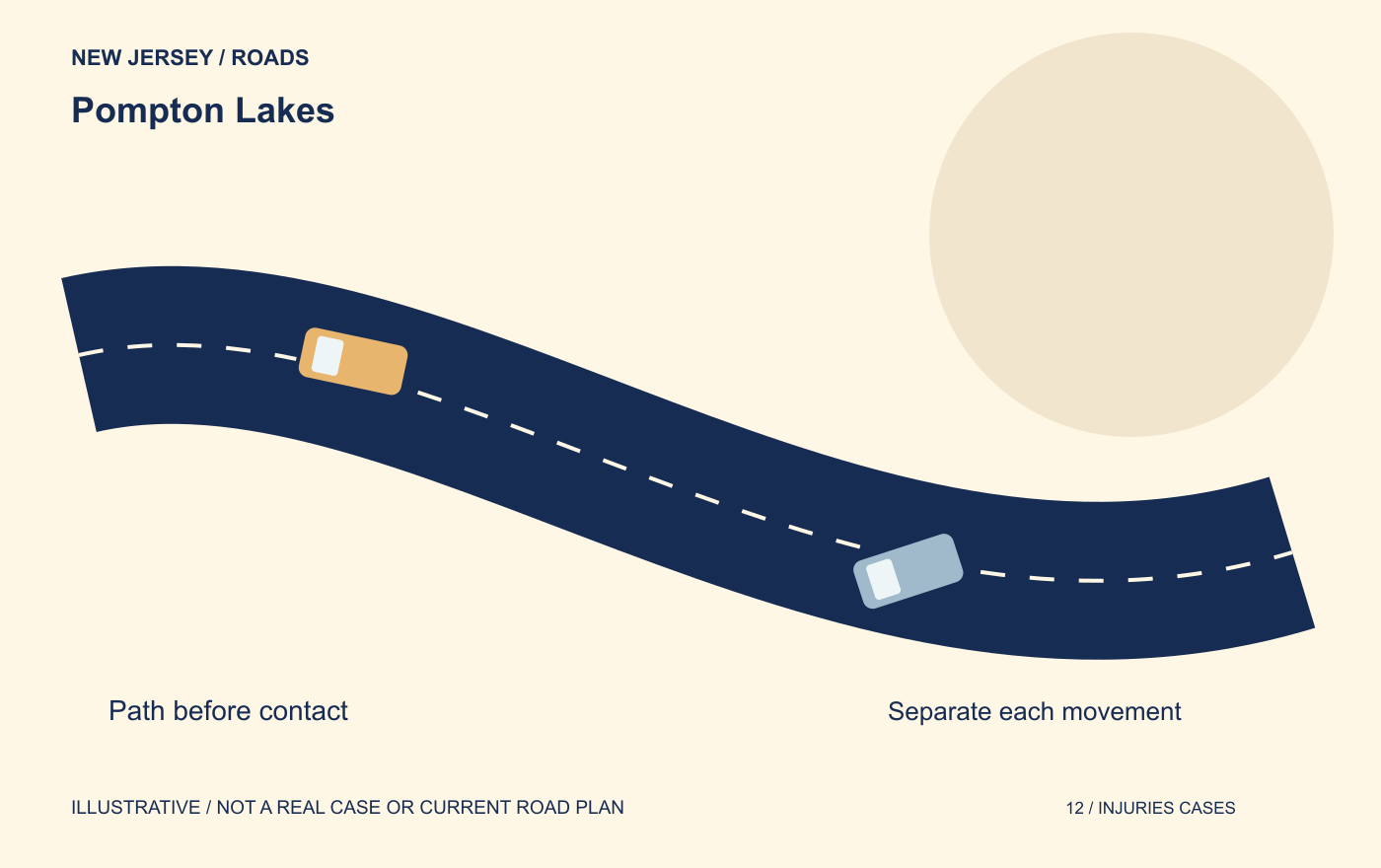
Two cars turning toward Lenox can begin in opposite directions on Wanaque. A third car may originate in the nearby driveway. Describe the origin before checking the time: the driveway entry is not simply another approach governed by the junction's morning window.
| Starting point and movement | Published period | Condition to establish |
|---|---|---|
| Northbound Wanaque, right onto eastbound Lenox | 7:30 to 8:45 a.m.; 2:30 to 3:30 p.m. | Monday through Friday when school is in session, including delayed-opening or early-dismissal hours. |
| Southbound Wanaque, left onto eastbound Lenox | The same school-period windows. | Same school-calendar condition; establish the other driver's original direction. |
| Driveway exit about 260 feet north on the eastern Wanaque curb, left turn | All times. | Identify that exit rather than importing the junction's school hours. |
Source check: October 13, 2026. Pompton Lakes Section 7-30.
Where did the car begin moving across your path?
If the other car came from the intersection, describe the road and direction it used before turning. If it emerged from a driveway, identify the opening you saw rather than assuming it was the junction. A photograph taken after impact may show both places, but it cannot identify the origin without the movement itself.
For example, a hypothetical car turns left at a junction while an oncoming car continues straight. In a different hypothetical situation, a car crosses from a property exit into the path of traffic already using the road. Similar contact could occur near the same block, but the approach and the driver's view would differ. These examples are not accounts of local cases.
If you first noticed the car just before impact, say that. You can describe where it appeared without claiming to know its entire route. A passenger or a continuous recording may help resolve whether it started at the intersection or farther along the curb.
The time is part of the local question
An explanation such as after school or during the morning rush is useful background, but it may not be precise enough to assess a timed restriction. State the time you know and what supports it. A timestamp from a recording, a message sent immediately afterward or another contemporaneous detail can help narrow the period.
Do not assume a school calendar or special opening schedule from an ordinary weekday. If that detail matters, ask how it will be checked. Similarly, if a collision happened before a rule was adopted or amended, a current table may not describe the rule then in effect.
You do not need to settle those issues yourself before seeking help. The important step is identifying them without treating a familiar daily drive as proof of permission or a current code entry as proof of the past situation.
Keep the local rule separate from the disputed movement
A timestamp near 8:45 a.m. needs its source and uncertainty stated. A receipt shows a transaction time; a recorded clip may have a device-clock offset. Do not round the collision into or out of a listed window. Use the school calendar for that date and actual approach controls rather than today's appearance.
Care and the next useful conversation
Call 911 for an emergency or an unsafe scene. Seek medical advice for injuries and follow the treating clinician’s instructions. Do not stop on an active road or ramp to reconstruct a collision.
For treatment payments, work losses, coverage and proposed releases, use the focused guides: New Jersey car accident help; PIP and medical billing.