Read the Orange location and sign condition together
If the other car paused and then entered your path, separate what you observed from the rule question. A stop does not identify the subsequent signal. Begin with the corner and the approach, then state whether you actually saw the motorist's light and the relevant sign.
| Source part | What it establishes | What it cannot establish |
|---|---|---|
| Section 200-47 | Central Avenue at Lincoln Avenue lists all right turns in the right-on-red schedule. | Not an all-signal ban on every right turn. |
| Section 200-21 | The movement concerns a steady red signal and official prohibiting signs. | The sign facing a driver on a previous date. |
| East Orange comparison | A different city and a different Central Avenue turn entry. | A nearby city's timed left-turn rule does not answer this junction's red-turn question. |
Source check: October 13, 2026. Orange Section 200-47; Orange Section 200-21.
“They stopped” leaves several questions unanswered
A driver might stop well before you reach the intersection, wait as you approach and begin moving as you pass. Another driver might complete a turn before you arrive and then change lanes. Those movements can produce different points of contact and different accounts of available space.
Explain what you actually saw after the stop. Did the front of the car begin entering the lane beside you? Was it already pointing along Central Avenue? Did you see it continuously, or did another vehicle obscure the approach until just before impact?
Stopping and entering traffic are separate moments. Include both if you witnessed them. If the only account of the stop comes from the other driver, identify it as their statement. You can explain the car's position at impact without pretending you watched its entire approach.
Where did the turning car enter your path?
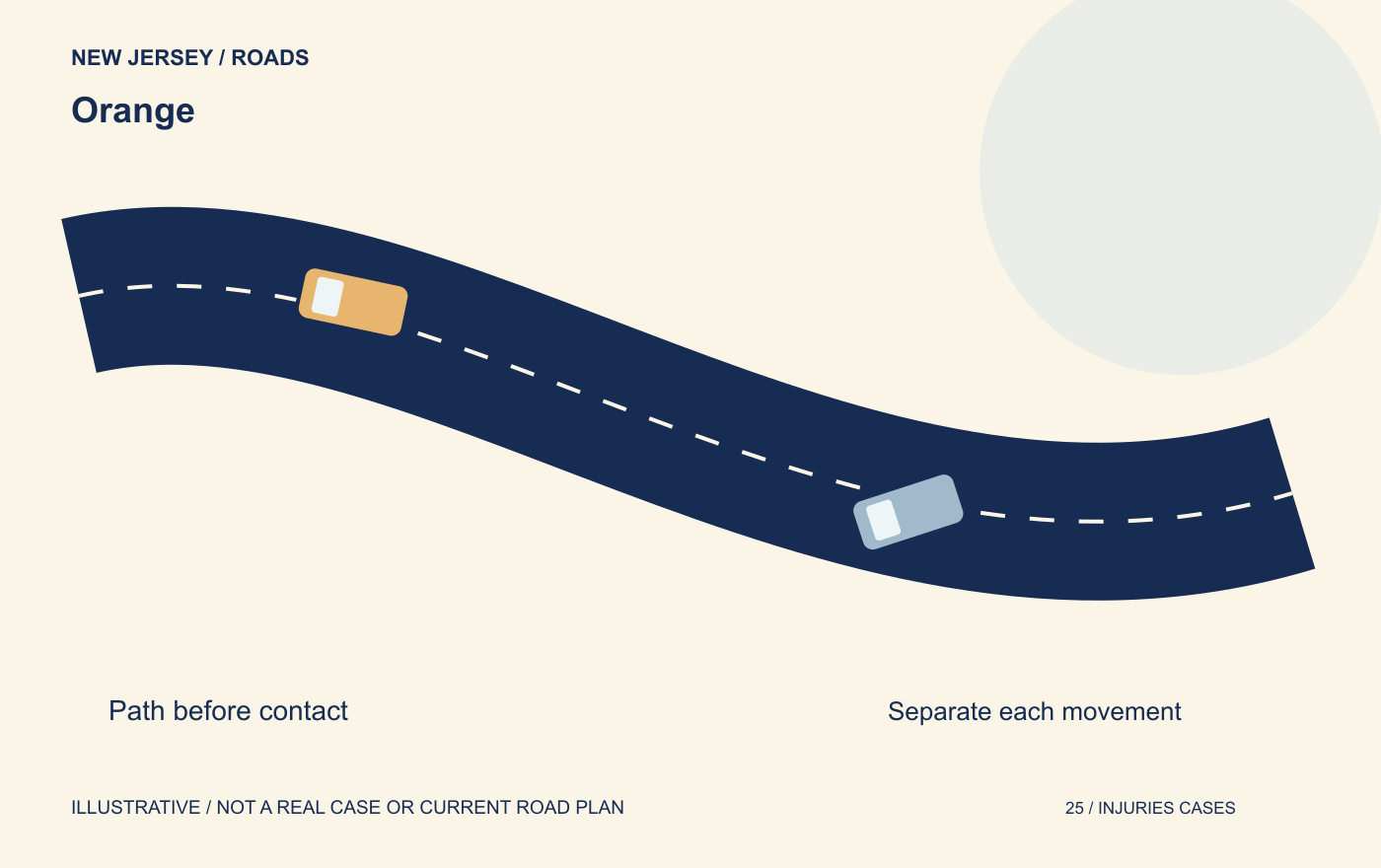
In a hypothetical situation, a car waiting on Lincoln Avenue begins turning right while a vehicle continues through on Central Avenue. The turning car's front reaches the continuing vehicle's side. In a different hypothetical situation, the turn is finished before the cars meet, and the contact begins when the newly turned car moves sideways into an occupied lane.
These are illustrative situations, not reported Orange cases. The useful distinction is where the vehicles first shared the same space. A description of a “turning accident” may hide a later lane change if it skips that transition.
Explain whether you were beside the car, approaching from behind it or coming from a different direction. If you were braking or moving over, include your movement too. A clear account helps a reviewer examine the collision without assuming that either driver's preferred label explains the whole sequence.
Keep the local rule separate from the disputed movement
If you did not observe a phone or another distraction, do not guess at one to explain the turn. The more useful inquiry here is the origin, signal, sign and first contact. If the car had completed the turn before a later sideswipe, describe those as separate movements.
Care and the next useful conversation
Call 911 for an emergency or an unsafe scene. Seek medical advice for injuries and follow the treating clinician’s instructions. Do not stop on an active road or ramp to reconstruct a collision.
For treatment payments, work losses, coverage and proposed releases, use the focused guides: New Jersey car accident help; PIP and medical billing.