Start with your route, not the whole interchange
A description such as 'near the 295 construction' may feel clear to someone who drives the area every day. For a person reviewing your accident later, it leaves several questions unanswered. Were you on I-295 itself, joining it from another highway, or driving on a connecting ramp? Which direction were you traveling? Did the impact happen before a sign, under an overpass or after you entered another road?
NJDOT identifies the Direct Connection interchange with I-295, I-76 and Route 42, within Bellmawr, Mount Ephraim and Gloucester City. That background helps orient a conversation. It does not locate your collision. Begin with the road and direction you know, then add the last sign or landmark you remember. If the ramp number is uncertain, leave it uncertain. A short accurate description is easier to investigate than a detailed route assembled from guesses.
What the illustration can and cannot show
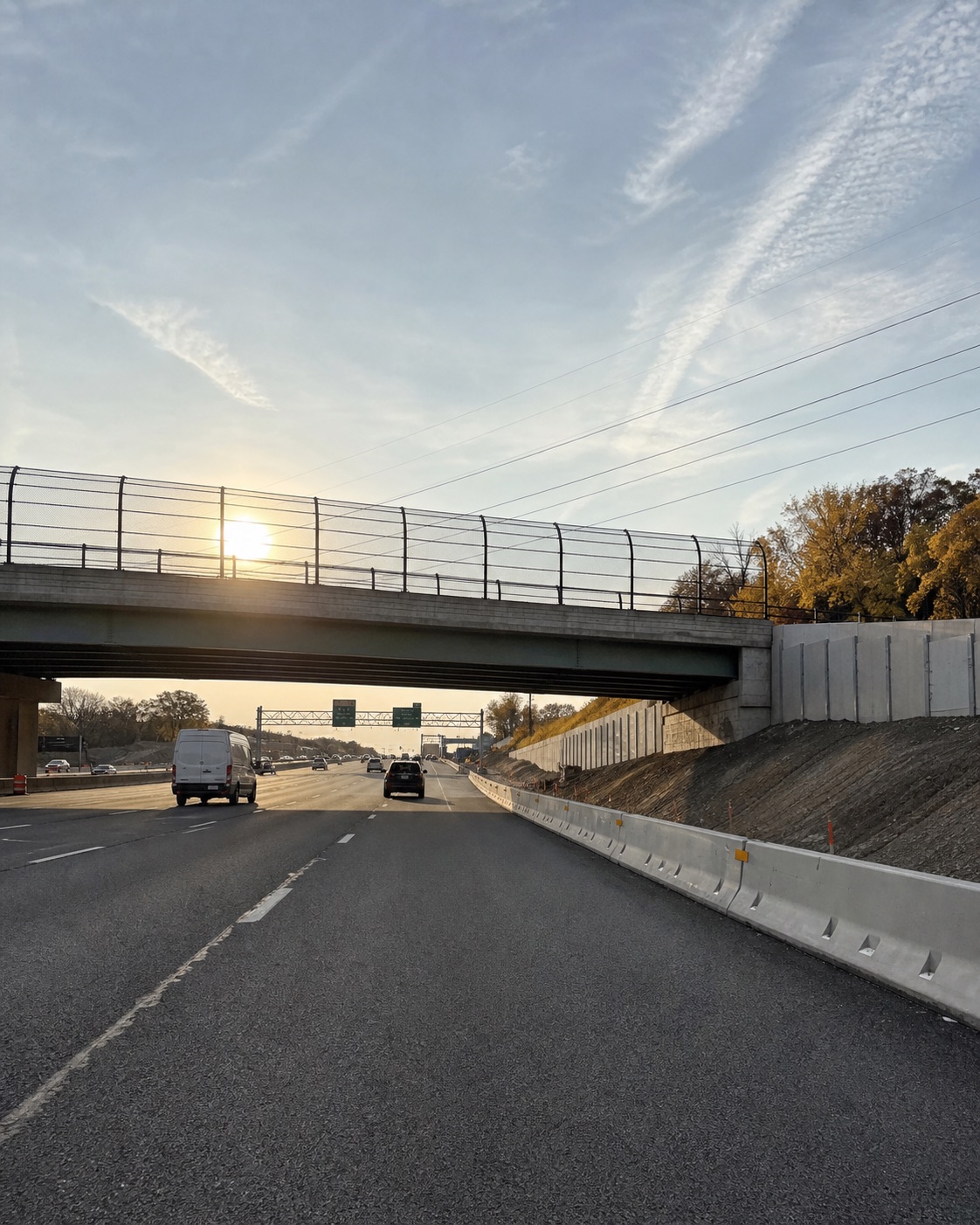
The accompanying image shows a generated highway scene with an overpass, a concrete barrier and traffic continuing ahead. It is an illustration inspired by the corridor, not a photograph of an accident or a verified current traffic arrangement. Use it to think about the features that matter in your own notes: an overhead structure, the side of the barrier, the shape of the lane and the view of the next vehicle.
Do not use this picture as proof of where a barrier stood on your accident date. Even a real image from another year might show a different arrangement. The question is what was present when you drove through. A photograph from your own vehicle, a witness account or an official record can be relevant to that question. The illustration is there to support understanding, not to fill a gap in the evidence.
Write the seconds before contact in order
A ramp collision and a rear-end collision in a stopped queue can happen in the same general area, but their descriptions should not be interchangeable. Start a short sequence: approaching the interchange, slowing, passing the sign, noticing the next vehicle, feeling contact. Record only the steps you remember. If you noticed a vehicle after the impact, do not move that observation to before the impact because it makes the story sound complete.
Describe your own position without deciding what another driver intended. 'The vehicle moved toward my lane' records an observation. 'The driver tried to cut me off' adds an interpretation. You can identify both, but keep them separate. If there were several impacts, number them in your notes and explain which one you actually saw. Noise and movement alone may not identify every vehicle involved.

Treat lane markings and temporary features as dated details
When people discuss this corridor, remembered traffic patterns can easily enter the conversation. A friend may recall an earlier detour; a search result may display a years-old construction notice. Neither establishes what applied to your trip. NJDOT project pages contain valuable background, but historical staging information is not a current driving instruction.
If a merge, cone line, temporary sign or barrier mattered to the collision, note the accident date alongside that observation. Keep any relevant official announcement with its publication date and stated coverage period. Say whether you personally saw the feature or learned about it later. Do not claim that a particular closure caused the crash merely because a project exists nearby. The feature, the timing and the sequence need to be considered separately.
Preserve context without returning to the shoulder
A wider image may help explain the road direction and surroundings; a closer image may show visible vehicle damage. Those are different jobs. If photographs already exist, preserve the originals and describe when they were taken. Note whether the vehicles had moved by then. A photograph from a parking area after the crash should not be labeled as the position at impact.
Do not walk into traffic or revisit a highway shoulder to improve your file. Your notes can acknowledge that a photograph was not safely obtainable. Passengers may have records that the driver does not, such as a message sent after the impact or a picture from a safe location. Keep those items with their original dates, and distinguish them from pictures obtained from someone else. Health and immediate safety needs come before documentation.

Make a vehicle and contact index
At a complicated interchange, the location is only one part of the file. List the vehicles as you can reliably identify them, the police agency if known and any report or claim number you have received. Avoid using the same shorthand for two different cars. If you call one vehicle 'the van behind me,' preserve that description when you summarize the sequence.
Create a separate contact entry for each insurer or representative. A repair discussion may be handled by a different person from a medical coverage discussion. Before sending documents, confirm which company and claim they belong to. Keeping the contacts separate prevents a common practical problem: having the right attachment but sending it to the wrong file. The index should stay private rather than appearing in a public account of the accident.
Read the report alongside your original notes
When an official report becomes available, compare its road name, direction and vehicle identifiers with your notes. Do not quietly rewrite your original recollection to make every detail match. If you recognize an error in your own notes, add a dated correction. If a report entry seems inconsistent, identify the specific entry and ask the issuing agency or a qualified professional about the appropriate process.
A report, a photograph and a witness account may each describe a different part of the event. That does not automatically make one useless. Explain the source of each detail. A passenger might have seen the vehicle beside you while you were watching the lane ahead. Keeping those viewpoints clear makes the file more useful than combining them into a single account that sounds as if one person saw everything.
Bring a focused question to the next conversation
Instead of asking someone to solve 'a crash at the construction,' bring the issue that is still unclear. It might be the precise ramp location, which insurer requested a document, or why a vehicle identifier differs between records. A focused question allows the next person to explain what additional material would help.
This guide organizes observations. It does not assign responsibility to a driver, a contractor or a public agency. An online article cannot establish coverage, diagnose an injury or predict a recovery from a corridor name. For urgent health concerns, seek appropriate care. For legal questions, discuss the actual accident records with a qualified lawyer. Start with what you know, preserve what you have and identify what remains uncertain. That is a more useful first step than trying to produce a confident conclusion yourself.