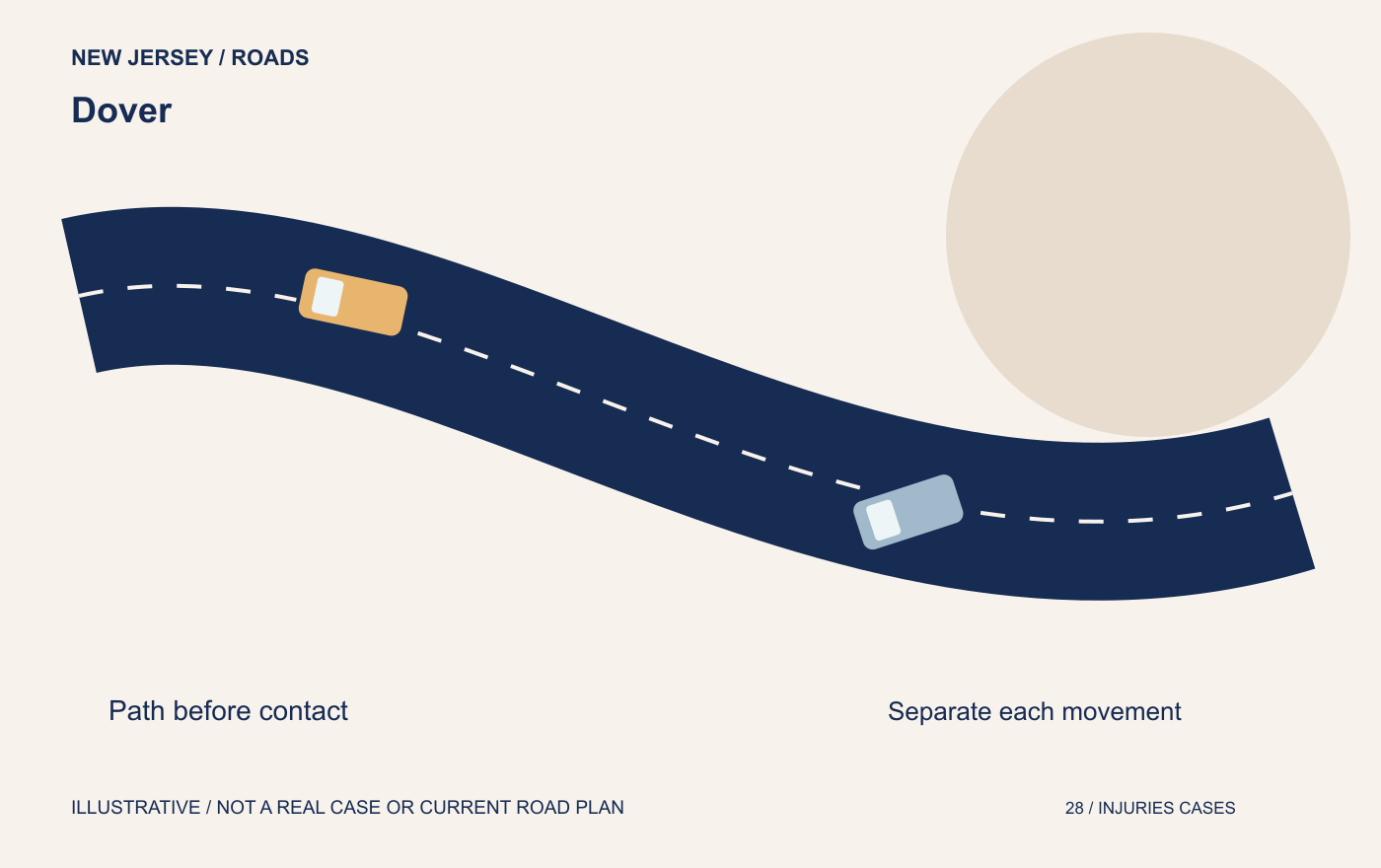
The Dover junction and Blackwell connector are different origins
The specific local distinction is between a turn at the Route 15 junction and a vehicle entering Route 46 through the West Blackwell connection. It matters even when both cars finally stop near the same landmark. Begin with the origin actually observed before first contact.
| Source locator | Dated source establishes | Collision-date question |
|---|---|---|
| Route 15/Route 46 junction | 2011 NJDOT notice describes the newly opened signalised junction. | Which origin and indication faced the turning car? |
| West Blackwell connector | Same notice separately identifies connection to Route 46 westbound, west of Rockaway River. | Did the other car enter there or was it already travelling beside you? |
| Intended route | A destination does not show a completed manoeuvre. | Did contact occur during an earlier lane movement? |
Source check: October 13, 2026. NJDOT August 11, 2011 Dover notice.
If the driver turned at the Route 15 junction
Explain the approach from which the turn began. Did you see a vehicle facing toward you before it moved across? Did it come from the side while you continued on Route 46? If you know the turn direction, state it. If you only saw the vehicle once it was already crossing your path, say that.
In a hypothetical situation, one vehicle continues toward the junction while another turns across its direction of travel. The inquiry concerns their positions, the point when the turn began and the signals relevant to each approach. This is an illustration, not a reported Dover case.
Describe your own signal and whether you actually saw the other driver's. A driver's statement that they had a green light does not establish a protected turn or the indication facing you. Ask for the actual signal arrangement and available collision-date evidence to be reviewed.
If the car entered from the West Blackwell connector
The first question changes from a signalized turn to the movement where the approaching car entered Route 46. Describe where the car was relative to yours before contact. Was it approaching from a separate path, traveling beside you or already ahead when it changed position?
A hypothetical entering car may move into an occupied lane and contact a continuing car's side. In a different hypothetical situation, a driver already on Route 46 may move toward an entering vehicle. These examples do not establish a local yielding rule or decide responsibility. They explain why both drivers' paths need review.
Do not assume a particular ramp length, sign or lane boundary from the 2011 release. An original recording or contemporaneous photograph can help show the arrangement that mattered. If the view begins only at impact, explain what it leaves out.
Keep the local rule separate from the disputed movement
The historical notice supplies named origins for a conceptual comparison, not current construction or lane instructions. Do not turn its westbound connector into an eastbound approach or assign a present signal phase from the old junction description. If the car was already beside you before contact, explain that separately from where it may have entered.
Care and the next useful conversation
Call 911 for an emergency or an unsafe scene. Seek medical advice for injuries and follow the treating clinician’s instructions. Do not stop on an active road or ramp to reconstruct a collision.
For treatment payments, work losses, coverage and proposed releases, use the focused guides: New Jersey car accident help; PIP and medical billing.